A Matter of Life and Death
Directed, Produced, and Written By
Michael Powell & Emeric Pressburger
“Would you die for her?”
“I would, but, er, I’d rather live.”
Abraham Farlan & Peter Carter in A Matter of Life and Death
Powell & Pressburger are the famous team behind films such as The Red Shoes and Black Narcissus, two films I plan on watching with Michael since I love them so much.
Michael: I liked this movie. I would watch it again. Especially those fifteen minutes I slept through.
Jordan: I knew you fell asleep!
Michael: Yeah, but only because I was so tired, not because I didn’t like the movie. I couldn’t help it! I haven’t slept well for three days!
OBLIGATORY SPOILER ALERT! (It’s hard not to really review without spoilering everything…)
A Matter of Life and Death is about a British WWII pilot, Peter Carter (David Niven), meeting an American radio operator, June (Kim Hunter), over radio communication just as his plane is going down. Peter has to bail out without a parachute, and he’s made peace with his fate. Fantastically, he doesn’t die during his leap, and he ends up on the same beach June uses to bike home every day. They fall instantly in love. Peter soon finds out he was supposed to die in the leap, but there was a mistake; he wasn’t collected by Conductor 71 (Marius Goring), a French fop who died during one of those pesky French revolutions. Peter argues the right to appeal to a celestial jury, saying that since he fell in love after he was scheduled to die the plan has changed, he is no longer ready to die, and he deserves to live.
Michael: I felt like Kim Hunter was a lot like Leonard DiCaprio in Titanic. She was so good, but when you think about it, her character didn’t really do anything.
Jordan: Yeah, she was kind of just there to be in love with Peter and then be worried about him. But she did it very well.
Michael: Oh, she was incredible!
Jordan: That opening scene between the two of them, they are both just acting their faces off! It’s a wonderful scene to open on after the introduction.
Michael: It’s very jarring! It pulls you in immediately.
I have really enjoyed every Powell & Pressburger film I’ve seen. This one is no exception. The inventive use of technicolor for the scenes set on Earth and the black and white for the scenes set in the celestial realm was really clever.
Michael: You don’t expect it. It turns the convention on its head.
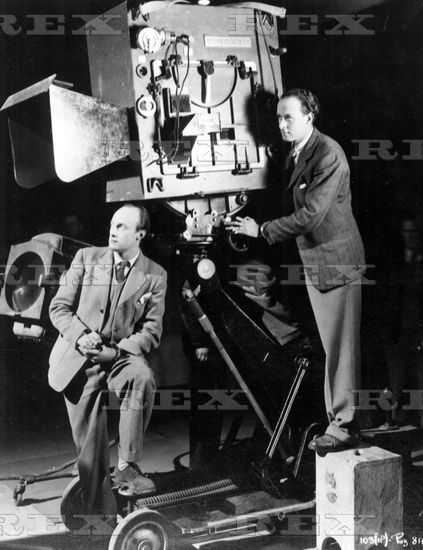
The film is full of inventive special effects, especially for 1946 and the fact that they were shooting with those GIANT technicolor cameras.
There is an astounding staircase that leads from Earth to the other realm. It is one of the best set pieces of the film.
Michael: I really loved that staircase.
The film was even retitled Stairway to Heaven when it screened in the US, despite the fact the term “heaven” is not used once in the script.
Powell and Pressburger have a penchant for exploring the most glorious sides of human experience. They take subject matter that may be weird or off-putting and transform it into very accessible material.
The pacing of this film may seem a bit slow, I suspect to make sure they don’t lose their audience as high concepts take over the plot. Everything is clearly and logically laid out.
There were several times I could see that a modern filmmaker would have been tempted to create unnecessary conflict between characters. For example, the character of Dr. Frank Reeves (Roger Livesey) could have easily not believed Peter when he started talking about being contacted by beings from another world telling him he should be dead. But Powell and Pressburger have such a fantastically light and logical touch that explains away any unnecessary complications to an already strange plot. They choose to have Dr. Reeves believe Peter completely so that he can properly diagnose what is happening to Peter and find a real world surgical procedure that will save his life. The fantastical is anchored in the realistic, grounding the film and showing how science and spiritual belief can co-exist.
On the other hand, there was a scene with Peter Carter wandering along a beach after his plane crash and finding a naked adolescent boy playing a flute while goats cavorted around him.
Michael: Why was that kid naked on the beach?
Jordan: I don’t know; that’s what I was wondering. I understand that they needed the Peter to think that he was dead, and the boy was like some kind of cherubic idyll with his goats and pan flute, but what was the practical reason he was there? This kid just sits naked on the beach every day with his goats because he likes it?
Michael: There was a short film that followed this movie, I don’t know why Criterion didn’t include it. It’s called “Boy Jacking Off on the Beach Gets Caught By Pilot”.
One thing that struck us both was the way the film viewed America. Powell and Pressburger had been asked by their producer to make a film that would repair any rifts that existed between the British and Americans that had been glossed over during wartime and by 1946 were threatening to tear the two countries apart again.
A Matter of Life and Death heavily relies on the differences between the two countries for the plot, using the denouement to show the rifts being healed. After all, the plot is driven by the fact that Peter is a British citizen in love with June, an American woman.
Michael: In older films, I can never get over that voice and articulation to make that false American accent that Americans always do.
Jordan: Well, they all had to have elocution lessons as part of the studio system. You’re coming at this as someone born in the 80s, so you have a post-post-modern viewpoint. Realism and naturalism didn’t exist in film the way we have it today.
Michael: It’s just something I can’t get over. These accents, either really proper or really low. And God forbid it’s British characters speaking really proper or just cockney nonsense! “‘ello, ‘ow ‘r ‘oo?”
Jordan: I loved the moment Peter said “She’s an American. I’m getting used to the accent.”
Michael: So was she!
Jordan: They sounded almost the same the whole time!
The prosecutor from the celestial realm fighting for Peter to leave Earth is Abraham Farlan (Raymond Massey), the first American to be shot down at the start of the Revolutionary War. Many of Farlan’s arguments during the trial revolve around how horrible the British are and how Americans are so upstanding. Peter’s defense argues that the two countries are not so dissimilar, and if the jury was changed to a group of American jurors (instead of the original jury which comprised members from every country that had suffered under British colonialism), it would be more fair and impartial. One by one, the jury members are switched to “true Americans”.
Michael: And bravo this movie! Cause when they were calling out the members of the jury and you were like, “Well, is there going to be an African American?”…
Jordan: The next person was an African American. I mean, there were no Native Americans…
Michael: No, and that sucked, but almost all of the Americans on the jury were immigrant Americans. None of them were what people are calling today “born Americans”. They all had an accent from somewhere else.
Jordan: I appreciated that all the jury members were immigrants except that last guy who was the “apple pie American solider” type. It shows people really thought of America a melting pot of all shapes, sizes, and colors throughout its history. It’s amazing that a film made almost 75 years ago is more accurate about our history than we’re being today.
Michael: But that’s the thing. Our grandparents’ generation was coming off that wave of immigration. So when this movie was made, that was very representative of America at the time.
Michael and I ended up talking for almost an hour about the different portrayals of race and class in the movie.
Michael: I loved the moment when the guy asked, “Is there an officer’s quarters [in the heavenly realm]?” and the woman answers, “Oh, no, that doesn’t matter here! Here, we’re all the same!” But then they show the spectators at the trial and everyone’s sitting together by race and class and are all in their stereotypical outfits…
Jordan: And sex–all the women are together, all the men are together…
Michael: Though it made me think of when my high school band director would get on us because people would see us when we weren’t performing and complain (because, you know, the South) that all the black kids sat together and all the white kids sat together. Our band director would say, “Stop segregating yourselves!” But the truth of the matter was we weren’t “segregating”, we were just sitting with our friends.
Jordan: But that was only happening because of the social constructs in the South.
Michael: Yeah, that’s true. My first boyfriend told me he knew I was gay because I was sitting with all the black girls. I get it now, but it made no sense to me at the time. Growing up on Guam my friends were from all over. I didn’t have that concept of “I’m going to be friends with the white kids because I’m white or black kids because I’m black.” But the people that grew up in North Carolina absolutely had that construct! Maybe that’s what it was like in this heaven or wherever they were.
Jordan: We’re about to go very broad. I mean…we could go broader…
Michael: Let’s all go broad! I’ll get wigs.
Jordan: Better than Conductor 71’s lace front wig.
Michael: Oh, my God! That fucking wig!
Jordan: It was puckering!
Michael: In live theater you don’t cut the lace because the wig deteriorates faster, but this was a mother fucking movie! His wig was meant to be a wig, but they also wouldn’t have had that lace front wig in the 1700s, so…
Jordan: This film, particularly the French character, was very theatrical and stagy.
Michael: I liked that character. He was kind of Puck-ish. You could never tell if he was on Peter’s side or not.
Jordan: And when he was on Peter’s side, he was still trying to trick him into going to the other realm instead of staying on Earth.
Michael: He was on his own side first and Peter’s side second. Cause the whole thing was his fuck up.
Michael: Now, am I crazy? Or would that movie make a great musical?
Jordan: I was thinking it was strange no one had ever made it into a musical! It could be great. Especially with that staircase! You think the staircases in Sunset Boulevard or Hello Dolly were grand? Well, you haven’t seen a staircase like this!
Michael: That French character would have such good musical numbers. We could have him played by Ru Paul. She would slay!
There always seems to be a musicality to Powell and Pressburger films, not just because of the pacing, but also due to the filmmaking itself. Everything glides in a Powell and Pressburger film, which has to be chalked up to the mastery of Jack Cardiff, their regular cinematographer. Many shots are slightly off kilter, but not in a way that appears weird or off-putting. If you pause the film and examine the shot, it’s as if someone hit the rotate button to 45 degrees, but somehow they are regularly able to put these shots in their films in a way that tells the story well and just flows.
There is such meaning in every shot. It’s beautifully filmed, but never just for the sake of beauty. It’s all in service to the story. The camera pans, pushes, tilts, zooms in or out, lifts and descends in crane shots. It’s never ostentatious, always masterful.
Somehow, you just feel wonderful watching a Powell and Pressburger film, even when the material may be sad or upsetting. There may be elements of the film that are very much of its time (read: obviously dated), but overall A Matter of Life and Death still stands up as a wonderful film, full of some of the best qualities humanity has to offer. While I don’t think it’s necessarily the best introduction to the films of Powell and Pressburger, you really can’t go wrong with it if you want to see what they were stylistically all about.
Michael’s Rating: Four Defending Your Lifes. [Defending Your Life, the heavenly comedy by Albert Brooks co-starring Meryl Streep, is not part of the Criterion Collection (yet), but we recommend it anyway.]
Note: Though A Matter of Life and Death isn’t currently streaming on Criterion Channel, they do have a collection of other Powell and Pressburger films that is well curated.
 Jordan & Michael Watch Movies!