The Importance of Being Earnest
Directed by Anthony Asquith
We live, as I hope you know Mr. Worthing, in an age of ideals. And my ideal has always been to love someone of the name of Earnest. There is something in that name which inspires absolute confidence.
Gwendolen in The Importance of Being Earnest
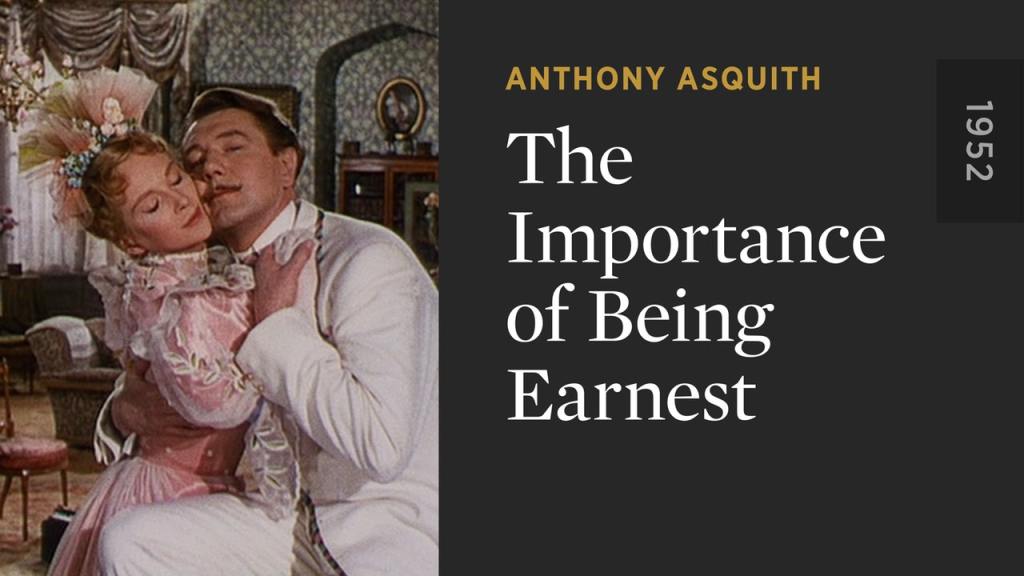
Jordan: I want to watch The Importance of Being Earnest.
Michael: Oh. I’m not really in the mood for The Importance of Being Earnest.”
Jordan: It’s in the Criterion Collection.
Michael: …bazd meg.
So we watched Anthony Asquith’s The Importance of Being Earnest, starting at 11:50pm on a Wednesday. When it was finished, I had one important question:
Jordan: So how much of it did you sleep through?
Michael: How dare you!
…
…
Michael: Only the second act.
Jordan: I knew it!
Despite all this supposed evidence to the contrary, Michael actually really liked this one a lot.
Michael: This is Oscar Wilde done INCREDIBLY well! I always forget how much I like The Importance of Being Earnest. I remember reading the play in high school and being like, “Oh! That’s funny!” Especially for being 16 and reading something that was quite old and feeling a connection to it.
SPOILER TIME! Though, honestly, the play is over a hundred years old and has been adapted numerous times. If you don’t know it by now, really, shame on you. It’s brilliant.
Jack Worthing (Michael Redgrave) lives in the country with his ward, Cecily (Dorothy Tutin), and her governess Ms. Prism (the incomparable Margaret Rutherford). To have an excuse to visit his friend Algernon (Michael Denison) in London, Jack has invented a ne’re-do-well brother named Ernest who lives in town and requires his constant intervention to save from complete ruin. While in London, Jack calls himself Ernest to give himself leave to do whatever he wants, including attempting to win the hand of Algernon’s cousin, Gwendolen (Joan Greenwood), despite the obvious displeasure it gives her mother, Lady Bracknell (Edith Evans). Events become complicated when Algernon rushes up to Jack’s country home to meet (and ultimately seduce) the fair Cecily by claiming to be the non-existent Ernest. The plot’s machinations become secondary: Witty banter is the name of the game. After all, this is Oscar Wilde! Through some crazy plot twists, kept from reaching melodramatic heights by the dry wit, the couples end up betrothed.
Michael: Remember when it used to be “Oh, thank God we found out we’re cousins! Now we CAN get married!”?
And remember when “Earnest” was code for a gay man? It helps to keep that in mind while watching–suddenly lines of double entendre become triple entendre.
This is a very straightforward film adaptation of the play. The focus was clearly on performing the text exactly as written, with little to no additional embellishments, and all performed by a perfect cast.
The actors interpret the characters very well and deliver the lines with precision without it sounding unnatural. They’ve clearly done their text work, knowing every word’s meaning and how to stress it, without sounding like they’re stressing it.
Michael: It was sort of the exact opposite of Make Way for Tomorrow, where this film was so whip cracking.
Jordan: It’s also very indicative of American versus British interpretation of the text. The script for Make Way for Tomorrow is a complete rewrite of that story for film. It very clearly emphasizes what it wants to tell you, whereas this adaptation of The Importance of Being Earnest just asks you to listen to what they’re doing. Now, Make Way for Tomorrow is also using a LOT of visual language that this film does not ever do.
Michael: I feel like the production meeting went like this: “Let’s just film the play.” “I don’t know, though, that might not make it film-worthy enough.” “Well, then let’s just add a scene where he smashes a bunch of glass!” “Ah! There we go! Now it’s a film!”
Jordan: Yeah, and they put in “Oh, we’re traveling on the train!” a couple times. But other than that, it was a very direct adaptation. It was very British, very dry, very straightforward. The text was the most important thing!
Michael: Something I appreciate about this film is they realized the play is gold so they don’t have to “paint the peacock” they just have to film the peacock. There are so many times when people say, “When you transfer it to film you have to be so much more! You have to tell us more! You have to give us more!” And while there can be some truth to that, people tend to stray too far away from the source material in trying to make it better for the medium. This film proves you don’t have to do that; if you recognize the source material is golden and stay faithful to it, you can have a really excellent movie.
Anthony Asquith used camera moves and close-ups sparingly for this adaptation. It was nice to see that there was no fear in just letting the play breathe in the space of a cinematic medium. There were two moments where close-ups were noticeably used.
The first I really hated. Gwendolen and Cecily have just met and are having tea. They are fighting over being engaged to Ernest, not realizing that when they speak of Earnest they are referring to two different men. Some of the best dialogue in the film happens as the women trade verbal barbs to cut each other down. Asquith decides to cut to a close up of the butler who is serving the tea after each line, showing the actor pulling a face as if to tell us how to feel.
I abhorred these cuts to close-ups. I didn’t need to be told how to feel, I was engaged in the story! Close-ups have been historically reserved to reveal characters experiencing deep emotion or some kind of inner shift. To have this tertiary character not only telling me how to feel, but also to be one of the only times close-up was used in the film was really annoying.
Michael: They had to show his reaction because this is the only moment the dialogue is underhanded. It’s the only truly SHADY part of the play.
Jordan: There are plenty of shady moments and reads…
Michael: This is the ONLY moment of shade. Everything else is a straight read. As clearly defined in Paris is Burning a “read” is telling you you’re ugly; “shade” is I don’t have to tell you you’re ugly because you already know it. They are saying nice things to each other in that scene, but they DON’T mean them. So we need the butler’s reaction so that straight people can understand they are NOT being nice to each other.
Jordan: I just didn’t like how it was filmed. I would have enjoyed the scene MUCH more had they kept the wide shot because the butler was already standing between the two of them in the shot; I don’t need the close up of his face to see how he’s feeling.
I really enjoyed the second time a close-up shot was noticeably employed. Lady Bracknell finds out that Ms. Prism is Cecily’s governess. She advances forward, her face filling the frame as she says, “Prism? Did you say ‘Prism’?!” This reaction propels the plot forward to the finish line, which is why I think it is one of the best (read: blatant) uses of close-up to indicate revelation. This is the moment all the pieces are about to be connected, and the close-up tells the audience, “Okay, here we go!”
Michael: I feel like people always talk about how gay Oscar Wilde was and how gay his work is, and it doesn’t really ever get driven home until you see it done WELL with HIS intentions. And that was this movie. It was done WELL with HIS intentions, and it’s the gayest fucking thing you’ve ever seen.
Jordan: And it’s so enjoyable! I can see straight people watching it and the gay stuff just flies right over their heads.
Michael: As it did in it’s time! Which is why he was so successful. He could write blatant gayness that gay people will be like, “Oh, honey!” but straight people will just be like, “Huh?” But they still love it.
Jordan: Because it’s still funny! You may not be catching ALL the layers of subtext, but you’re catching the surface layer and maybe one or two deep, which is still funny.
Michael: It’s like being a kid watching Golden Girls. I don’t know who Fess Parker is, but I know it’s funny when they say Dorothy looks like Fess Parker. Now, it’s funnier when you know who Fess Parker is, because she does kind of look like him, but even not knowing the reference you can still find it funny.
Michael: I think the production meeting also went like this: “So we’re doing Oscar Wilde…that means everyone’s a drag queen, right?” “Yes, absolutely.” Because that was the GAYEST thing I’ve ever seen, from start to finish. I couldn’t tell if Algernon and Jack were going to fuck in act one. They entered like, “Oh, good morning, we just had sex last night, now let’s fight about your girlfriend!” Then we have that scene between Cecily and Gwendolen…I mean, I’m convinced Gwendolen was a man! That voice she was using! And then the costume designer was like, “How wide can I go on these costumes?” And the director was like, “WIIIIIIIIIIDE! Use all our budget on those three dresses!”
Jordan: And when Gwendolen opened her parasol and there was layer upon layer of cloth dangling down! There were five layers of cloth, just to make her parasol!
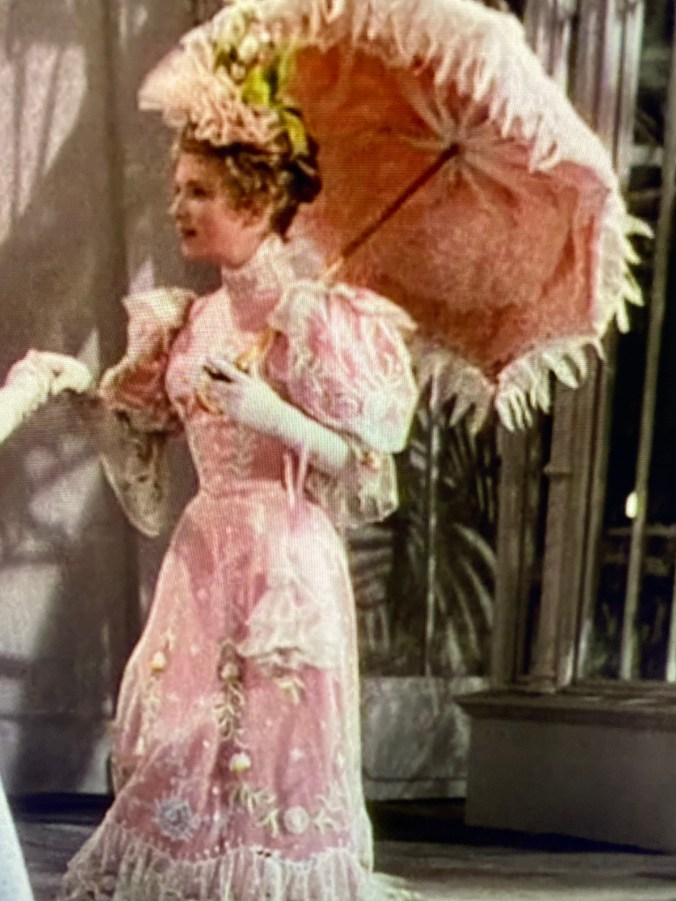
Michael: It’s like, how do we make this bigger for the movies? The sets and the costumes! The stage play would never have costumes like that! I was gagged in Gwendolen’s third act dress because it had that neck. That form fitting material that went up her neck to a point behind her jawline!
Jordan: She could not move her head. That dress is keeping you a proper lady at ALL TIMES.
Michael: Not because you can’t get out of it, but because you HAVE to stay upright! THAT’S the way in which this became a movie thing. The intricate sets and incredibly detailed costumes that wouldn’t survive an eight show week or would be prohibitively expensive to try. Here, where she’s only going to have to wear it for a few days on set, we can throw all the money at these six dresses.
Jordan: And the details you can see when Lady Bracknell slowly takes off her coat in the third act.
Michael: All that beadwork!
Jordan: That was a really smart filmmaking moment. You can have the character take off her coat onstage to reveal that she’s now interested in staying, but not to the point where she loosens a button and now some of her fancy dress is showing underneath. On a stage the audience would never been able to see those small reveals as she loosens her coat to indicate warming up to the idea of Cecily and Algernon’s marriage. She would have to pick a moment to just take the full coat off. But on a movie screen, she can do it little by little because the camera is so close.
Michael: I think this is a masterclass of how to take a play and put it on film.
Michael’s Rating: I wanted to give it 100 powdered wigs, but that feels wrong. So I give this movie Ten Gay Bars!
And a bonus thought for your day:
Michael: I need a remake of The Importance of Being Earnest starring the cast of Harry Potter. We get Daniel Radcliffe playing Jack, Rupert Grint playing Algernon, Emma Watson and Evanna Lynch to play the women (either which-a-way, I don’t care), and obviously Maggie Smith to play Lady Bracknell.
Hey Hollywood: Make it happen!
 Jordan & Michael Watch Movies!
Oscar Wilde would be so thrilled with your ten gay bars. Wish I’d been watching with you.
LikeLike