Holiday
Directed by George Cukor
I’ve been working since I was 10, I want to find out why I’m working. It can’t just be to pay bills and pile up more money, even if you do the government’s going to take most of it. … The world’s changing out there, there are a lot of new, exciting ideas running around. Some may be right and some may be cockeyed but they’re affecting all our lives. I want to know how I stand, where I fit in the picture, what it’s all gonna mean to me. I can’t find that out sitting behind some desk in an office, so as soon as I get enough money together, I’m going to knock off for a while.
Johnny Case in Holiday
Holiday is one of my very favorite Cary Grant and Katharine Hepburn outings. I’ve always thought it forms the centerpiece of an unofficial trilogy with Bringing Up Baby and The Philadelphia Story. It’s still a type of screwball comedy, but the humor is more sophisticated and grounded. (Side Note: I was validated in this thinking by one of the special features on Criterion’s blu-ray of Holiday where an esteemed film critic said the same thing.)
I was actually nervous to have Michael watch this one. I always am nervous when I have him watch my favorite movies. Will he like them? Will we be able to watch them again together? Or will it be another film I need to put on the list of Movies to Watch When Michael Isn’t Home?
Michael: I feel like this movie was incredibly acted from all angles. There was no weak link, no “I would’ve liked to see someone else in that role”.
Jordan: I like that every character has an arc. They all start in one place and end somewhere else in the end.
Michael: And they all take this ride together. The movie was very well designed, the costumes were amazing, the scenic design was incredible, the composition of the shots was unreal. Who directed this?
Jordan: George Cukor.
Michael: [correcting my pronunciation, though I pronounced it how everyone else pronounces it] Cukor. “C” goes “ts”. It just goes to show that Hungarians do everything better. From classic Hollywood all the way to modern pornography, we’re just good at film.
SPOILERS AHEAD! And not just for this film, but also for things like The Philadelphia Story and Andrew Lloyd Webber’s Love Never Dies, the horrifically awful musical sequel to The Phantom of the Opera. I actually suggest you go watch Holiday RIGHT NOW before reading this review. And, fair warning, we gush quite a bit about this movie…
Johnny Case (Cary Grant) has met the woman of his dreams during a Christmastime holiday to Lake Placid. He arrives back in NYC to tell his friends Nick and Susan Potter (Edward Everett Horton and Jean Dixon) that he is engaged to Julia Seton (Doris Nolan), and he’s off to meet her family. The Potters worry that Johnny knows so little about Julia, but Johnny doesn’t care if she doesn’t have a cent! He’s in love, and that’s what matters! Johnny arrives at Julia’s house to find out Julia is one of those Setons – an incredibly rich banking family whose grandfather built an empire from nothing in the 1800s. Johnny meets Julia’s high functioning alcoholic brother Ned (Lew Ayers) and her sister Linda (Katharine Hepburn), a headstrong young woman with ideals that don’t line up with her father’s values.
Michael: It didn’t even occur to me. It’s like, “Oh, it’s a Cary Grant and Katharine Hepburn movie.” We get into those opening scenes where we meet Julia, and it didn’t even occur to me to be like, “That’s not Katharine Hepburn. Hey, wait a minute!” Then we get to that scene in the elevator where Linda pops her head in and I was like, “Oh! Yeah, that’s right!”
Jordan: And it’s such a great entrance for her, too. She throws those doors open and you know exactly what that character is about. She’s so strong…
Michael: She’s a force!
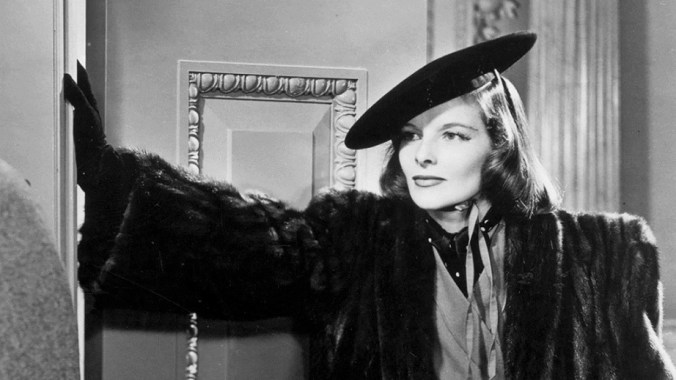
Jordan: Yes. And Julia’s not exactly a wilting flower when you meet her, but then Linda opens those doors and you see, “Oh, this is the strong person!”
Julia believes Johnny has the same kind of ambition and drive as their grandfather, which she assumes will satisfy her demanding father (Henry Kolker). Johnny reveals he has been working since the age of 10; it’s time he actually live some life and figure out where he fits in the grand scheme of things. He’s set on taking his savings and travelling, exploring the world and not working at the daily grind for a while.
Michael: You see the “we fell in love on vacation, now we’re back in reality”, and immediately you know Johnny was the same person on vacation that he is in real life; Julia was someone else. He talks about who she was in that first scene, and then we meet her and question, “Is she who he thinks she was?” You can tell she really enjoyed the vacation, the holiday of it. But for her it was just a holiday, now it’s time to go back to reality.
Jordan: And she thinks that’s Johnny, too. She’s heard he’s worked since he was ten years old and is very industrious, working his way up in the world. She thinks he’s the same person as her grandfather, which is why she falls in love with him, not realizing he’s not the same person. Johnny worked out of necessity. What he really wants is to have a childhood, he wants the opportunity to grow up. If he goes and works in her father’s bank, he doesn’t get to grow up and find out who he is.
Linda thinks Johnny is the best thing to ever happen to her sister. She wants to make her sister’s marriage work with this young man no matter what it takes. Linda, Julia, and Ned conspire the best ways to get their father to accept Johnny. The film follows the course of Johnny’s relationship with the Setons over the weeks leading up to and following the New Year. He even meets the family’s cousins Seton and Laura Cram (Henry Daniell and Binnie Barnes).
Michael: Even those cousins were great actors. The second you meet those cousins you’re like, “…Gross. You two are gross.”
There are many themes that kick around in the film – parents and their children, sibling relationships, how people think about their place in the world, the pressures of expectations, the way people may be in love yet not know each other at all. The film seems so light and effervescent and then reveals utter truth about the characters and their situations. Cukor finds ways to easily infuse these seemingly lighthearted scenes with realistic melancholy. It’s a masterclass in how the comedic form doesn’t have to be pure fluff; it can reveal human truths just as deeply as the most serious drama.
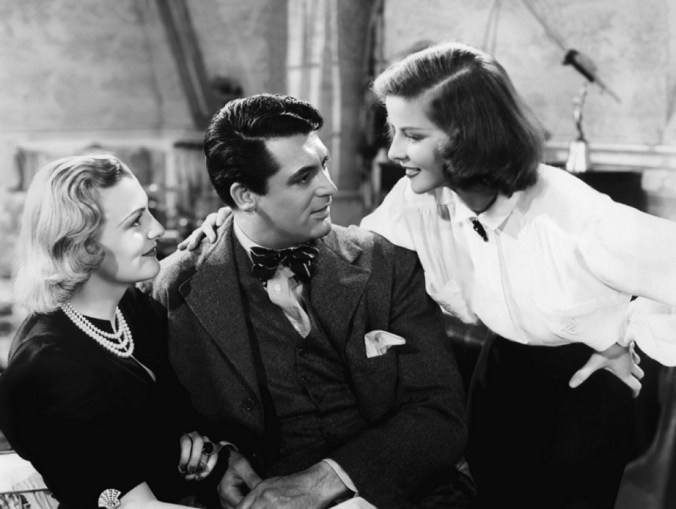
Jordan: Cukor was known as more of an actor’s director. He was clearly about working with his actors and giving them a space in which to perform. He then built on the visuals from that.
Michael: I liked the composition of the shots. There are those moments in the playroom where Linda would turn and reveal the fire in the fireplace behind her. It was like, “Come on, metaphors!” The fire and passion inside her!
Jordan: And there are those moments with the set design, like when Johnny first walks into the Seton’s house and it looks like a cavern. Then the playroom is cozy and warm, whereas father’s study is all wood and very stiff. There are those visual touchstones throughout the movie, but they aren’t set up to be super clever. It presents the space, and then the actors are in the space.
Michael: It’s one thing to have a good shot or interesting camera angle or movement, and then it’s another thing to do it just for the sake of having an interesting camera angle. I think it’s the mark of a good filmmaker to say, “Here’s what’s happening, this is the best way to capture that” versus really poor filmmakers who say, “I want the camera to do this because I think it would be cool if that’s what the camera does, so how do I force the characters into position for the camera to do this!”
Jordan: So far we haven’t really watched a movie [we’ve reviewed] that has done that yet.
Michael: It’s a much more modern concept, the “cool camera angle”. It’s the “I knew that it had to end with Meg shooting Christine!” and they’re going to force everything so that happens.
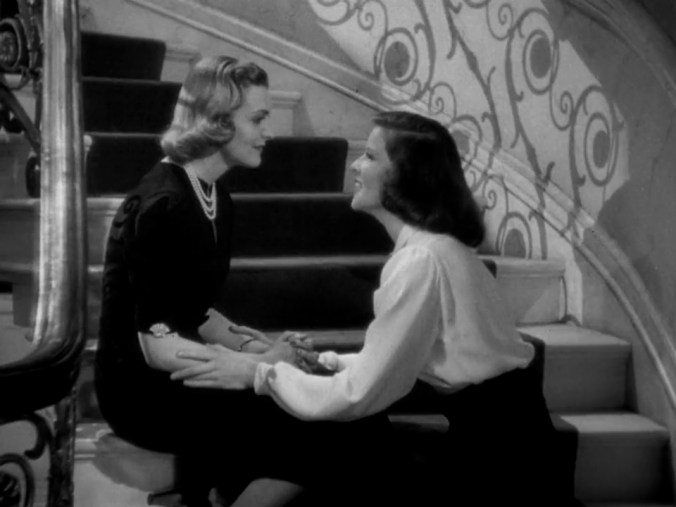
Usually it’s the oldest child in these stories who is the one that’s more upright and aligned with the parental values. In the original play Julia was the older sister. I like that they switched it for this film. It adds more layers to her relationships with her family members. The film shows the younger sister leapfrogging the older sister to be the first one married. There is rebellion in all three of the siblings, it’s just that Julia’s rebellion fits in with her father’s world view whereas Linda’s and Ned’s does not.
The dynamic between the two sisters is wonderfully played out. They go from having this shared bond over Julia’s engagement to the engagement causing friction. Linda thinks that Julia has found a free spirit, someone who will breathe life into their stuffy family. She doesn’t realize that Julia’s wanting something very different from her marriage. Julia feels Johnny can really make something of himself, but he won’t be able to do it if he loses momentum by refusing to take what her father is offering. Linda can push as much as she wants for the marriage to take place, but it won’t take place if Johnny rejects the life Julia wants.
Eventually Linda realizes that all the times she’s fought to take her younger sister along with her rebellious ideas have been the wrong thing for their relationship. There are clues along the way, especially when Linda offers to throw Julia an intimate engagement party with family friends in the playroom in the attic, but then Julia goes along with her father’s idea to have a lavish New Year’s Eve party at which the engagement will be announced. Linda pouts, hiding in the playroom all night, eventually drawing up Johnny and his friends the Potters to have the intimate party she wanted the whole time. This scene is the centerpiece of the film. Linda doesn’t realize until later how much the intimate party is not what Julia wanted, and Linda was, in effect, trying to force her wishes upon her sister.
In a family where the father is so strong handed with his children, it doesn’t occur to the eldest and youngest siblings that the middle child may actually want the things their father wishes for them.
Michael: Was Linda steamrolling Julia her whole life? Probably. Was she doing it on purpose? No, she most likely wasn’t. She realized too late that she does that kind of stuff.
Jordan: She was just thinking she was taking her sister along with her while Julia was probably thinking, “This is my older sister who wants to do these things. I want to make her happy.”
Michael: And Linda didn’t realize this person she was dragging along was being dragged along. She didn’t realize there could be some resentment.
Jordan: What’s interesting is that Julia was never able to have this kind of confrontation with Linda until she had this relationship with Johnny. Even though Johnny isn’t right for Julia, there’s something about that relationship that helped her grow up as well. It allowed her to realize, “No, father’s life is the life I want. This is what I want to be.” And she can now say that to her siblings without them thinking she just doesn’t get it.
Throughout the film Linda refuses to outwardly acknowledge the romantic feelings that are growing inside her for Johnny. She fears she’s falling in love with him, but she won’t act on those feelings because Julia says she’s in love with Johnny and Linda wants her sister to be happy.
Michael: It just went to show how good of a person Linda was. It was very Angelica and Eliza from Hamilton. …There’s that scene during New Year’s where Johnny kind of leans in to kiss Linda and you see how much she wants it and is struggling with it, but she’s like, “No, no…you should go.” She realizes he’s the one she should be with, but he doesn’t realize it, not until the end of the movie. And they don’t play it that way, with Johnny wanting Linda the whole time, because this filmmaker wasn’t an idiot! Johnny doesn’t realize Linda’s the one he wants yet! He realizes he likes her, he realizes there’s an attraction…
Jordan: He has a lot of fun with her…
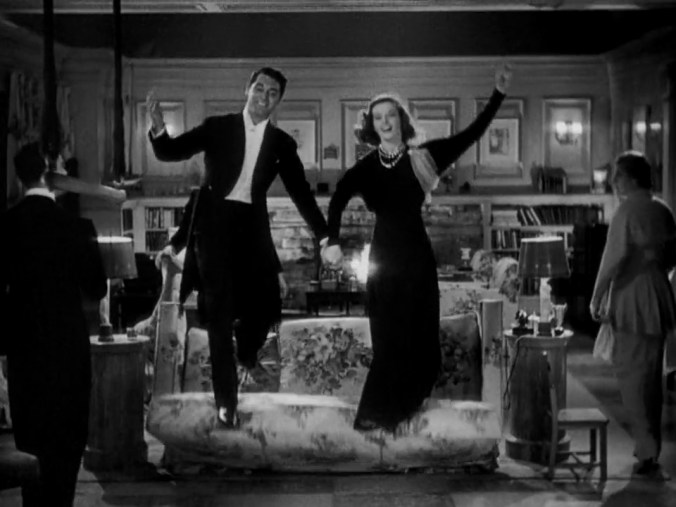
Michael: He wants to give her a kiss and a hug, but to him it’s just a kiss and a hug. For her it’s sooooo much more. So she realizes, “I can’t enjoy this. I’m starting to enjoy this too much.”
Jordan: You can tell that Johnny is not self-aware. He doesn’t know he’s falling in love with her. He’d be fine marrying Julia and just having fun with his sister-in-law, Linda. The first moment he’s actually aware that Linda is the person he’s going to miss is when he’s saying goodbye to everyone towards the end of the film.
Michael: Katharine Hepburn…what an incredible performance. That character’s intentions are so clear and so present!
Jordan: I love that scene in the playroom where she’s confronting her father about how he doesn’t understand her, how her mother understood her, and she turns around and you see the tear fall!
Michael: Oh! It’s brilliant! She’s like, “I’m not going to cry in front of you, but the second I turn my back…!”
Jordan: And the only reason you see it is because of how the shot’s composed.
Michael: Was it on purpose or was it on accident? I like to think it’s a happy accident, but…you know what I mean?
Jordan: I think it’s one of those things where Cukor knew who he was working with. He knew Hepburn was going to deliver that level of performances. Maybe the tear wouldn’t have fallen at that moment as they were shooting…
Michael: So good!
Jordan: …but I think this was their fourth film together, so they knew how to work together so well that they could build that scene.
Michael: And maybe it happened in rehearsal and he was like, “Move the camera to the left.”
Jordan: Maybe!
Michael: One of my acting teacher’s biggest things was the strongest emotion you can portray to an audience is trying to not have the strongest emotion. If you cry, the audience won’t. But if they see you struggling not to cry, then they can cry. And it’s that moment of strength where Linda is ready to lose her shit, and she just…won’t…do it… and then she turns and has that moment of release! And even though that moment wasn’t going to make me cry, somebody somewhere is watching that scene and thinking, “God, I wish I could say that to my father,” and they’re losing their minds over it.
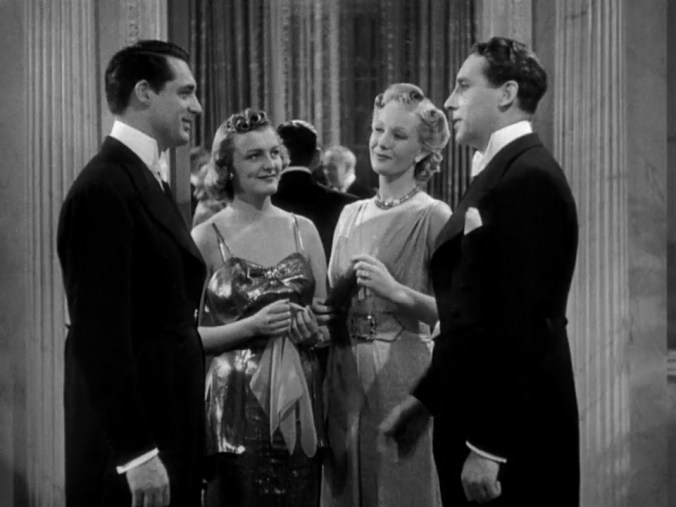
Michael: Those cousins are just the epitome of two-facedness. It’s great to have characters like that because it reiterates there’s still that bit of fakery in Ned, there’s still that fakery in Julia, but Linda is just authentic. She’s not pretending she’s someone else, it’s not like that’s her problem.
Jordan: And that’s her father’s problem with her.
Michael: Yes, it’s only her problem because her father and sister have a problem with her being authentic and how she doesn’t want to pretend for the sake of appearances. That’s Ned’s problem; he can’t be himself, so he drinks to help him cope with the oppression.
Michael: I love when old movies have a gay brother.
Jordan: A gay drunk brother!
Michael: Well, that’s why he’s drunk! They’re trying to make it like he’s sad and has riches and ennui!
Jordan: Well, it’s actually he’s an alcoholic because he’s so beaten down by their father that he can’t cope.
Michael: He can’t just go out to the gay bar and S that D. He knows he’s going to have to settle down with a nice girl and work at the bank… [Lew Ayres’] acting while he was drunk was unreal!
Jordan: It’s one of my favorite “drunk” performances. Ever. I love it.
Michael: Because it’s just real. And it’s so understated. It was one of the exact examples of acting my teacher would give. When you have to act drunk, you don’t act drunk, you act “I’m not drunk, I’m holding my shit together”. Because that’s what drunk looks like!
Jordan: And there’s that whole scene where Linda is realizing she’s falling in love with Johnny and she’s miserable, so she asks her brother what it’s like to be drunk.
Michael: Oh, my God! “Will wine do it? Give me some more!” And he’s like, “Here’s a tich…you’re not doing this.”
Jordan: And that’s the thing! There are so many sibling layers they are exploring through the whole movie! Because you know that their mother must have died and the three of them have been holding on to each other so tightly.
Michael: Because their father wouldn’t.
Jordan: Right! And this is the moment where she’s asking what it’s like to be drunk, and he’s telling her what it’s like for him, what it does for him, what it does to him, but he’s also saying, “I’m not giving it to you.” He’s going to be the little brother protecting his big sister. He knows it’s not what she really wants to do to herself.
Michael: He knows she doesn’t need it. He needs it. He’s drinking because he’s self medicating, and he’s aware of it. Which is also a very interesting choice. Instead of making him the rich party boy, he’s aware of his situation. It’s so much more interesting to watch characters who know what their problem is, but they feel like they can’t fix it or there’s nothing they can do about it. Or they know what they can do about it, but they just can’t make the decision. Like at the end, where you want him to leave with Linda, and he says, “I can’t”, I think it’s safe to say that everyone who is watching this movie understands, “No, he can’t.”
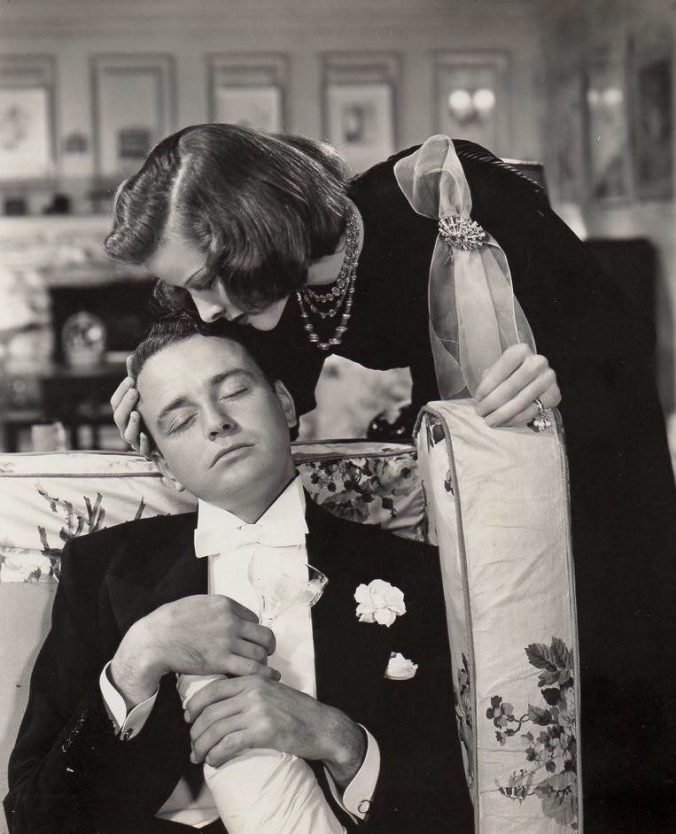
I think this film really earns the “happily ever after” ending between the Grant and Hepburn characters more than any other. In Bringing Up Baby you know they’re going to end up together because it’s screwball comedy, and that’s just what happens. In The Philadelphia Story they end up together, but the main relationship the audience has watched is between Hepburn and Jimmy Stewart’s characters. Yes, it feels right when Hepburn and Grant end up together at the end of that film, but in Holiday it feels like such a triumph! Johnny stays firm and decides it’s more important to find out who he is than to rush into a marriage that, while stable, would keep him from an opportunity to grow up on his own. Linda doesn’t just choose the man she loves, she’s chooses her own life as well, a life that may or may not include her family in the future. The film drives these stories home by having such outstanding and complex supporting characters.
Michael: This movie was kind of like a really well done science experiment. When you have your really well done science experiments, you need to have your hypothesis and the test group and the control group. You have Johnny as the experiment. Is he going to give up his ideals or stay firm and run away? That’s why we need the character of Ned; he’s the control group version of Linda because they’re in the same position. You have to show the person that’s going to stay so that the person who leaves is that much more of a relief to the audience. If it was just her running off with him, it wouldn’t be as emotionally fulfilling. We see the version of her that stayed. We’re happier for her leaving because we have Ned staying.
Jordan: And we have Julia, who does want a guy who has passion, which is what she saw in Johnny. She thought Johnny had ambition as well, but he just didn’t have it for the business world. He had ambitions about finding out who he was. What Julia wants is a man with passion and ambition towards the same ends her father values.
Michael: She wants someone with a mind for business and a bod for sex. All she wants is Working Girl.
Jordan: Yes, Harrison Ford would be perfect for her.
Michael: No, not Harrison Ford! Melanie Griffith! Fast forward fifty years, make her a lesbian, and she’s all up in it!
Michael: I enjoyed this film very much. I would absolutely watch this movie again. It has rewatch value. The performances are so good, you want to see them again.
Jordan: Yeah, the first time I watched it I thought, “Oh, what a cute romantic comedy!” The second time I watched it I realized, “Oh, it’s really a family drama!” The writing is so strong, and Cukor directs it so well. Everyone is on their A-game the whole time. All the layers in the script are able to be unpacked and delved into in this adaptation of the play.
Michael: And it really takes it’s time, but it’s not a long film. It uses its time very well. Which is why when I hear people say things like, “Oh, they just didn’t have time to tell the story” about other films or plays, I’m like, “Yeah, they did. It’s just that no one knew how to tell the story in the time allotted.” And this movie in the time allotted…wow did they tell you a whole story! They tell this whole story between these two people, and all you ever see is their first kiss. And that’s all you need. The end. No question mark.
Michael’s Rating: Five Pretty Womans.
(I’m not supposed to tell you this, but “Five Pretty Womans” is basically the highest rating he could ever give anything. So YAY!)
 Jordan & Michael Watch Movies!