Something Wild
A Jonathan Demme Picture
“Look, if you don’t turn around and take me back, you’re gonna make me do something that I don’t wanna do!”
“I can hardly wait, Charlie.”
Charlie Driggs & Audrey “Lulu” Hankel in Something Wild
Something Wild is one of those ultimate 80s movies that isn’t very much of an 80s movie. It’s a road trip, it’s full of cliches, it’s self referential, but it’s also unique, quirky. While the rest of the 80s were obsessed with big hair, big sound, big colors, Something Wild reaches for something else; it’s showing what it was like to actually live in the 80s. Beneath all the surface gloss, the yuppie culture, the counter-culture, the bombastic sounds by one-hit wonders, there were people living their lives and trying to figure out how to feel satisfied in a world that didn’t seem to meet expectations. It’s fascinating to see how our society just keeps cycling through these similar mindsets over and over.
Something Wild is at heart a road movie. Stand far enough back and you see it’s about how two people take a journey together to escape from their current lives. One is trying to escape by breaking free of their daily life and the recent upsets they’ve incurred, the other is trying to escape by going home to rewrite their history. It’s a road movie with a destination, but it’s about getting lost along the way.
Michael wasn’t feeling well when we watched this movie, and it didn’t grab him very much, so he didn’t have a lot to say about it.
Michael: It’s not something I’d watch again, or something I feel I needed to see.
But for those who are intrigued, I have a lot to say about the movie.
SPOILERS, of course!
Charlie Griggs (Jeff Daniels) is a Wall Street yuppie who has just received a promotion, but he feels unfulfilled with his life. He spices up his routine by attempting to duck out on a bill at a small diner in downtown New York City. He’s spotted by a woman (Melanie Griffith) who introduces herself as Lulu (we find out later this is not her legal name), a character who is surely the precursor to that horrendous “manic-pixie-dream-girl” stereotype (which seems to completely miss the actual person underneath the facade). After giving Charlie a hard time about not paying his bill Lulu offers him a ride, and he accepts. What follows is a road trip out of New York City, through New Jersey, and into the heart of Pennsylvania as Lulu “abducts” Charlie from his Wall Street life and takes him on an adventure.
The plot and general character outline seem trite and cliche, tropes we’ve all seen before. But director Jonathan Demme and writer E. Max Frye do more with them. They construct a film that gives you the underlying reasons why these people are the way they are. None of this is revealed by dramatic confrontations. Sure, there are a few moments where the characters break down and confront each other, but these moments are few and far between. The focus is more on presenting these people as real. It’s the film’s asset, but it also creates the danger of losing the audience in the first act.
Michael: It was just like, “Oh, hey, here’s this story about this Wall Street guy who sees this girl and she kidnaps him, but he doesn’t seem to care cause he wants to fuck her, and then he fucks her, and she keeps him kidnapped…” I don’t know. It seems like a very of-its-time story of “I just met this wild woman and she took me on this adventure. It was so out of my comfort zone.” It’s not realistic. It’s a very fantastical story.
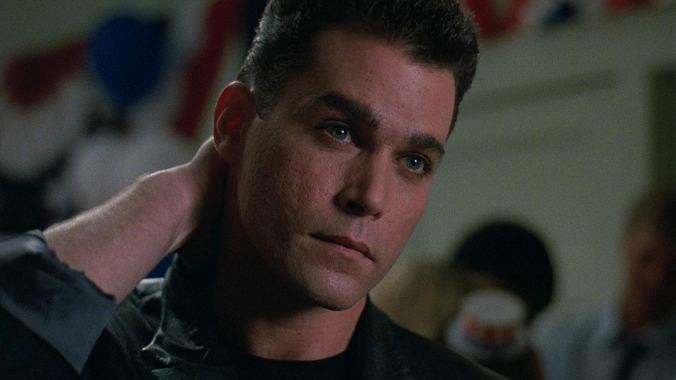
Jordan: It is, but there’s that moment where it turns. It starts off like it’s going to be this typical romantic comedy where the straight-laced guy meets this “wild” woman, but then Ray shows up (played by Ray Liota) and it gets dark and realistic. You find out that Lulu is not this “wild” woman, she was taking advantage of Charlie’s desire to break out of his life.
Jonathan Demme directs Something Wild with the same kind of energy he directed the Talking Heads concert movie Stop Making Sense. It’s no surprise that a David Byrne song opens the movie. “Loco de Amor” (sung by Byrne and Celia Cruz) sets the absolute correct tone for the movie. It wanders from verse to chorus to bridge in what seems to be three disparate styles that somehow create a unified song. It trips and meanders, but it sounds good as a whole. Demme’s film is a lot like that. There are a variety of song styles employed throughout and a variety of ways they are presented. There is a garage band playing a high school reunion, a sing-along car ride with hitchhikers, the usual songs used as score, all ending with a direct address song sung by Sister Carol East after a final scene cameo while the credits roll on the side of the screen.
Michael: The soundtrack for this film was just all over the place. Especially when you see the credits at the end, and it’s just any song about being “wild” or any song with the name “Charlie”, oh yeah, that’s good, put that in the movie! You know what this movie needs? Reggae!
There is a tendency to go back to the song “Wild Thing” throughout the movie. It’s a touchstone for the whole film, seemingly because the name of the movie contains the world “wild”.
Scratch the surface, though. I found I was thinking a lot about what it meant to be wild in this movie. “Lulu” clearly starts out as our “wild” character. She’s dressed slightly off kilter. She has a bob haircut that’s deep black. She wears an assortment of large jewelry, bracelets, rings, necklaces, all that seem to be worldly or tribal in nature. Nowadays people may shout and point fingers: “Cultural appropriation!”
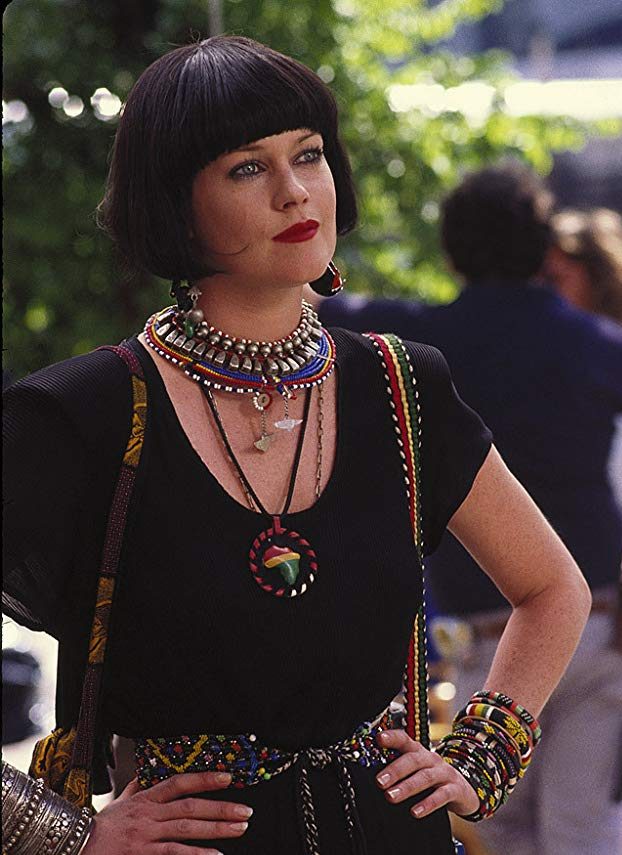
But it seems like the movie is trying to say more about what wasn’t in the mainstream eye at the time. Demme fills the frame with “real” things. The movie is shot on location at average looking locales. Gas stations, motels, consignment shops, used car lots, diners – these are the locations that populate the movie.
There is so much Americana shown, but it’s not idealized. It’s just places people live. They are practical. Lulu takes Charlie to her mother’s house. It’s not the usual suburban/rural childhood home seen in movies. It’s one storey, there’s no sidewalk in front, the houses around it are not all cookie cutter. It is actually normal rather than the Hollywood projection of what “normal” is. The “wild” elements become more and more about the way one lives their life and the way different people’s lives all coexist in a seeming jumble of cultures, styles, and desires.
Lulu changes her appearance so much throughout the film that I felt I never got to really know her. I think I know what her wants are, but then the end of the movie happens, and I’m thrown for another loop. This is why she seems like the “manic-pixie-dream-girl” precursor, but it’s also the reason she is not that trope. Everything “wild” that she does is from an internal motivation that she doesn’t reveal to the audience. We have to put those pieces together. The movie gives us enough of the pieces to understand what’s going on in this moment of her life, to see why she’s attracted to Charlie, to understand that she’s grasping for a life that she hasn’t been able to live even if she’s not entirely clear on what that life is supposed to be. She’s playing with the outer forms to try to reach an inner satisfaction. Because there is no point in the script where she flat out tells us, “This is what I want and this is why I want it” she seems less accessible to us. Sadly, this can also fall into the trap of making her the “unknowable, mysterious woman”. To think of her that way would be reductionist. She’s more complex than just being “unknowable”.
Charlie is more accessible. He wears everything on his sleeve, despite the fact that he’s a good liar. We understand the attraction he has to Lulu. We also understand why he continues to use the name “Lulu”, even though her legal name is revealed as Audrey halfway through the movie. He respects the reinvention of herself. She’s using the name to help break her out of whatever life she’s had before. It’s the same thing that Charlie is attempting to do by going with her on this trip.
Charlie is unhappy with his life. He doesn’t know what to do to fix it, but he knows whatever it is doesn’t fit into how he has been living. The marriage, the kids, the stable job with opportunity for advancement: none of it has made him happy. His marriage has dissolved, his relationship with his kids is strained, and he hates his job. The things he thought would fulfill him are falling apart, and he’s realizing he was never happy with them to begin with. He recognizes the same feelings in Lulu. Her life growing up didn’t make her happy. She attempted to break out of it by making choices socially viewed as “wild”. How many of the choices she makes now in her life come from being trapped in that label, and how many of them are her expressing her real self? Maybe she doesn’t even know anymore. It’s not going to stop her from trying, though.
It’s these qualities that attract Charlie and Lulu to each other. They see complimentary qualities in one another. Charlie has access to “normalcy” that Lulu does not. She needs someone to come home with her, to introduce to her mother, to take to her high school reunion. Does she know very few people are fooled by the act? Who is Lulu really trying to fool, the people from her past or herself?

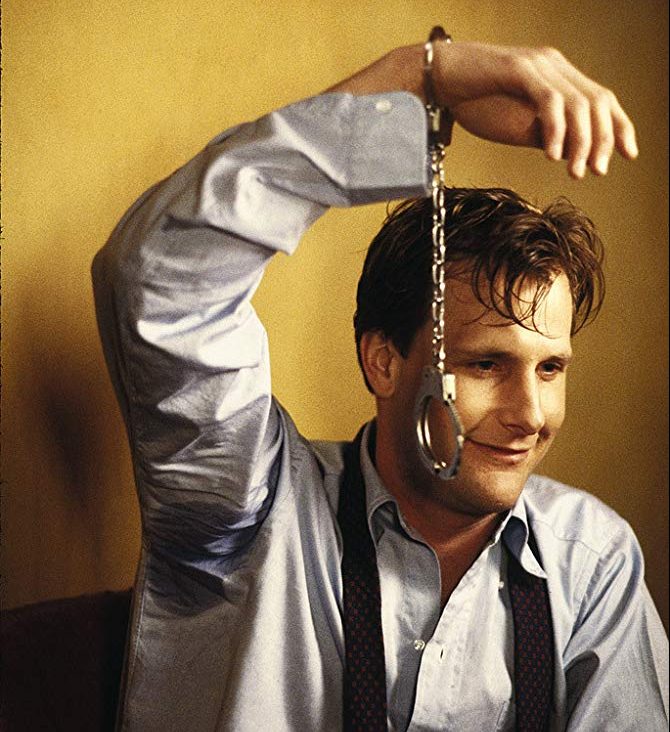
Lulu is trying on another look. She’s trying on what she thinks Charlie’s life is, seeing if it fits, if she can do it. She feels betrayed when she finds out that Charlie’s life isn’t what she thought it was. “I get involved with a married man who isn’t even married!” she yells at him. Meanwhile Charlie becomes ever more bemused by the life that Lulu reveals to him. After intense handcuff sex in a dirty motel room, the last thing Charlie expected was to be brought home to mother. He tries to keep up with Lulu, but can’t match what she’s doing. It’s only when he stops attempting to be more like her and starts being more like himself that he is able to integrate who he is with the way he thinks he wants to be. “You were right. I’m a rebel. I am! I just channeled my rebellion into the mainstream,” he says.
Throughout the movie Lulu’s hair has been an indication of different states of her character. She starts in the black bob, introducing herself as Lulu and projecting the “wild” woman facade. She reveals her natural blonde locks in a short and sassy style when she brings Charlie home to mother and transforms to Audrey. There’s a sense of getting closer to her real self, but it’s still stylized, and she’s still lying. She tells everyone that Charlie is her husband, they want kids, she’s now the dutiful, happy homemaker. As events progress and her actual husband, Ray, appears, her hair starts to droop. It loses the shine and the luster. It falls limp. But it looks more natural.
Ray is manipulative and abusive. He has a raw sexuality that is easy to see why Lulu would be attracted to him in the first place. It’s also easy to see why she would want to get away from him. Ray is the “wild” man she was attracted to, just like Charlie is attracted to the “wild” woman she represents to him. Ray, like Lulu, is aware of how attractive he is to other people, and he uses that attraction to get what he wants. There is a moment where Ray manipulates a young shop girl to get what he wants from her, promising her he’ll be back in a couple days. “You’re gonna be here, right?” he asks her in a desperate tone of voice. The desperation is due to his need to find Charlie and hurt him, but the shop girl doesn’t know that. It reads to her like this handsome man is desperate for her.
Michael: I do feel bad for that little girl he’s never coming back to. She’s going to sit around just waiting for him…writing in her diary…he never came back, she’s going to think, because of her… Bless her.
One of the ways the movie might alienate audiences towards the beginning is the way it chooses to initially express Charlie’s and Lulu’s desires to break out of social constraints and expectations by being “wild”. When we first meet Charlie he skips out on a bill at a cheap diner. Sure, he owes maybe $3.50 for his meal, but he’s cheating what is clearly a locally owned business of their money and stiffing the low wage server of a tip. Lulu likewise robs a liquor store owner when his back is turned because she needs cash. Charlie tells Lulu that he’s married and has two kids, yet he’s checking into a cheap motel room with her to have sex.
Both Michael and I agreed it was kind of a shit way to set up your main characters. Even when you find out Charlie’s wife has left him by having an affair and taking the kids from him, it’s still difficult to jump that initial hurdle of watching him and Lulu rebel against society by committing crimes (while petty) against local business owners and people who clearly are not well off. They both want to rebel against societal constraints, but I think there’s a difference between rebelling against society and directly affecting people’s livelihood. After all, the mom and pop Italian restaurant owners they stiff a third of the way into the movie aren’t the same as the corporate Wall Street company Charlie works for and hates. The guy working the register at the Italian restaurant is actually “Pop”!
Personally, while I disagree with these decisions the characters make, I understand why the filmmakers use these moments to set up the character’s desires to break out of their lives. It’s petty crime, it’s not lasting or damaging in the long run, and by the time the movie ends it’s clearly something that neither of them want to do again. The movement from petty crime (for Charlie a new thing, for Lulu a supposed regular thing at this point in her life) to another type of life altogether by the end shows how the characters have grown and changed. They don’t want to hurt people, they just want to figure themselves out and feel free.
We know this because Ray shows up halfway through the movie. Ray is the personification of “wild” gone bad. Sure, the “wild” behavior Lulu and Charlie engage in can be seen as selfish, but Ray’s behavior is manipulative, cruel, and focused on destruction. While Lulu and Charlie just want to feel free, Ray wants to damage, control, and force the world and the people in it to be what he wants. If he can’t make people do what he wants, they are disposable. He won’t let anyone damage his pride because he will always exact revenge threefold. He’s breaking society’s rules in a way that doesn’t set himself or anyone else free. This juxtaposition of Lulu’s crimes versus Ray’s crimes are what shows Charlie (and the audience) how “wild” can go bad. Personal responsibility cannot be discounted, no matter how free one desires to be.
The idea of desiring to break out of one’s life is cliche, but it’s cliche for a reason. I keep thinking about the many movies produced in the 80s and 90s that talked so much about being dissatisfied with the corporate culture and wanting to break free of that. Nowadays we have the anti-Millennial arguments and “okay, Boomer” culture. It’s revealing that this isn’t an old argument. These “generational” clashes are more inherent in the fabric of our society than we care to acknowledge. Of course Millennials are going to want to spend more money on avocado toast and life experiences! They grew up watching popular movies and television that all expressed the Boomers’ and Gen-Xers’ complaints about how horrible it was to be trapped in their unfulfilling lives of yuppie Wall Street culture and corporations that didn’t respect or care about the employees.
Something Wild captures that theme in a more complex way than most of the other popular movies of the time. It doesn’t solve the character’s problems. Sure, they drive off together at the end. Lulu has reinvented herself yet again, Charlie has quit his job. Where has Lulu been? What was she doing? Why does she look the way she does? All these questions indicate the start of another adventure that they are going to embark upon together. Charlie could now be viewed as the “wild” one. He has given up his yuppie life and style. He knows whatever happens, he wants it to happen with Lulu. Now here’s Lulu in a classy 80s lady outfit, complete with hat. We don’t know what her hair is now. Will it be natural? Will it be another facade? We know it’s hidden, just as she’s always hidden something. The adventure will be in the reveal later. And Charlie is up for playing the facade with her because he knows who she is underneath. At least, we hope so…
Michael: It was just a fine movie for me. I didn’t want to shut it off, but I wasn’t terribly invested. They just weren’t characters I cared about. The movie starts off introducing them as “Neither of these characters are good people. And go!”
Jordan: Yeah, that is the downside to it. It seems to lie to the audience because the characters are lying to each other. We don’t know that yet, though. So it’s hard to start getting invested in the characters because the audience is believing their lies as they are telling them. That will determine whether you like the movie are not. Are you going to be someone who finds it interesting to see the layers peeled back as the movie progresses?
Michael: Do you take in the big picture at the end and say, “Oh, I see where they were both coming from”? Or is it too late because you had taken them at face value to begin with and are now like, “Eh, I don’t care”?
Jordan: Yeah, the first time I saw it I was thinking, “I don’t know if I like this movie.” What turned it for me was Ray Liota’s character showing up because that’s when I was like, “Oh, I see what’s going on.”
Michael: The turning point for me was Jeff Daniel’s butt. That’s when I was like, “Okay, I’m interested.”
Michael’s Rating: Two and a half handcuffs
 Jordan & Michael Watch Movies!
Pingback: The Silence of the Lambs | Jordan & Michael Watch Movies!