Swing Time
Directed by George Stevens
Listen. No one could teach you to dance in a million years. Take my advice and save your money!
Penny Carroll in Swing Time
Swing Time is one of those joyful, classic musicals from the 1930s. It showcases Fred Astaire and Ginger Rogers at their finest. The plot may not be the strongest, but it has some enjoyable twists and turns, keeping everything so light that even situations that would be regarded with heavy seriousness in other films are breezy and inconsequential. The main theme is joy, an ebullience of life. The whole film flows so elegantly, due in no small part to Rogers and Astaire themselves. Roger Ebert has included the film on his list of “Great Movies”, saying, “When you see anyone–an athlete, a musician, a dancer, a craftsman–doing something difficult and making it look easy and a joy, you feel enhanced.”
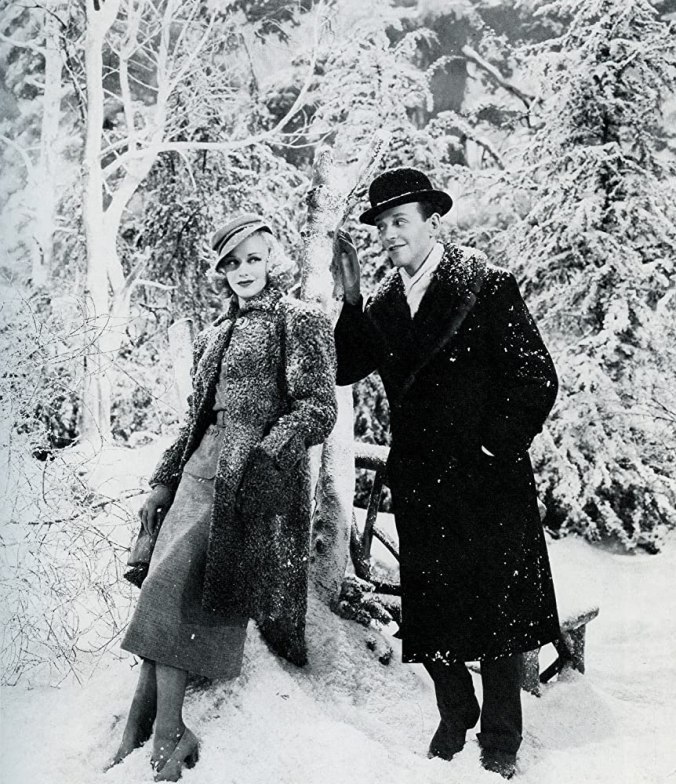
Michael: I just feel it’s 60/40 for me. On one side it’s this really enjoyable light hearted musical comedy, the other 40 percent is just, “Ew, David!”
I’m a little more 80/20 on this one, the 20 I dislike being the uncomfortable “Bojangles of Harlem” number. If it weren’t for that number, this would be a 100 percent wonderful classic film musical. It’s very disappointing to me that so many great musicals up through the 50s seem to require a blackface number, always in the guise of a tribute to black performers while neglecting to feature any non-white performers. As it stands, this number is a reminder of America’s social and filmic history, which I personally think should never be ignored no matter how uncomfortable it might make us since they point to societal structures and attitudes that persist today.
SPOILERS FROM HERE ON OUT! Dance away if you don’t want the plot ruined.
John “Lucky” Garnett (Fred Astaire) is about to get married. He’s been on tour with a traveling show as a star dancer. When they played his hometown he decided to leave the tour and marry his former sweetheart, Margaret Watson (Betty Furness). Lucky’s cast mates do not want to see him leave the show (after all, if he leaves, they may not have a show anymore!) and convince him he’s wearing the wrong style of trousers for a wedding. He needs to get them mended. While Lucky is preoccupied with his trousers, the cast intercepts calls from the father-in-law-to-be demanding Lucky’s presence or the wedding is off. Though Lucky misses the wedding, he still shows up at Margaret’s house and is charming enough to strike a deal with her father: If Lucky can amass $25,000 to prove he’s reliable and able to provide for Margaret, he can marry her. Lucky sets off for New York City with his friend and former cast mate, Pop, in tow.
Michael: I did not like Pop. Is that the same actor who played the father in Make Way for Tomorrow?
Jordan: I don’t know. I don’t think so, but let’s look it up. *Consults Criterion insert* Yes! Victor Moore! Good eye, babe! I enjoy him, but I understand why you don’t like him.
Michael: I think he talks so slowly and awkwardly. It’s an energy killer for me.
Jordan: It’s a character choice he’s making.
Michael: I just don’t like the character.
Lucky and Pop arrive in New York City without any money or luggage (Lucky’s case opened and spilled his clothes all over the train tracks as they tried to catch the last train out of town). Lucky’s still wearing his wedding clothes, so people take him for a gentleman. After a meet cute involving making change for Lucky’s lucky quarter, Lucky follows a Ms. Penny Carroll (Ginger Rogers) to her job as a dance instructor in an attempt to apologize for confusion Pop instigated. Penny wants nothing to do with Lucky after the trouble he’s caused her, but her boss reminds her she can’t turn away a potential client. Penny airs her frustrations to her friend Mabel Anderson (Helen Broderick) before attempting to teach Lucky to dance.
Michael: I could have used more of Mabel. I liked her. She was sassy. They should have gotten rid of Pop and had her be both Lucky’s and Penny’s friend.
Jordan: How would that have worked?
Michael: I don’t know. They’re smart people working on this movie, they could’ve figured it out.

Once Penny’s boss sees how wonderfully the pair dance, he arranges for them to audition together at a local night spot. After several adorable mishaps and some flirtatious fighting, Lucky and Penny are ready to audition to be the main dancers at the club; but there’s an obstacle. The band leader, Ricardo Romero (Georges Metaxa), refuses to play for them on the grounds that he loves Penny and does not want her to dance with another man, regardless of the fact that Penny has repeatedly turned Ricardo down in the past. Lucky spends the next several scenes gambling to win Ricardo’s contract so he’ll have to play for them.
Over several more wacky and adorable scenes, Lucky and Penny begin to fall for each other. Lucky doesn’t want this to happen; after all, he’s promised to marry Margaret as soon as he makes $25,000. Pop tells him he doesn’t need to worry about that until he’s made the money, and he might not ever make it, so why not just go for it with Penny? Lucky decides to keep everything above board, not be alone with Penny, and not break things off with Margaret. Just when he’s thinking he might change his mind and go for a relationship with Penny, she finds out about his pending engagement and closes the door to all romance. She eventually tells Ricardo that she’ll marry him. But that cannot stop her chemistry with Lucky…
The plot continues to weave and dance just like the characters onscreen until Lucky and Penny end up happily in each other’s arms.
Michael: I loved the costumes and the sets. The acting was very of its time. There’s that double take concept from films of this time (and beyond) where people are all, “Yes…wha, NO!” I’m always like, “That worked, huh?” I mean it must have worked at the time, and it worked on me as a kid. Like in Pinocchio where Jimminy Cricket does that a lot.
Jordan: It was the style at the time.
Michael: I was up and down about the whole movie. There were some things I really enjoyed and some things that rubbed me the wrong way. I think it’s a cute little story. But right from the jump it’s his cast mates trying to sabotage his wedding. Not, “Oh, haha, we played a trick on you” but legitimately trying to stop him from getting married through trickery.
Jordan: Just because they didn’t want him to leave the act.
Michael: Exactly. Then he goes off to the city where he meets this woman and is like, “Oh, I want to be with her!” But not in a way where he’s going to let Miss Thing back home know they aren’t together anymore, more in a kind of I’m going to have my cake and eat it too kind of way. He’s like, “If I don’t ever hit $25,000 dollars, I’m just going to ghost this bitch, so everything’s fine!”
Jordan: Well, Lucky doesn’t come up with that plan, Pop does. Lucky’s still saying he’s going to go back when he gets the money, and if he doesn’t go back he has to break it off. He keeps making distance between himself and Penny and only decides he’s going to give in and kiss her right when she finds out he’s engaged. So she stops anything before it happens, which makes him decide he doesn’t need to tell Margaret anything since he’s ready to go marry her.
Michael: Then there’s that minstrel number. Then there’s the whole end sequence where they stole that Ricardo’s pants. What did he ever do to them? You said that he was a jerk, but he just didn’t want to play music so the woman he was in love with could dance with some other guy.
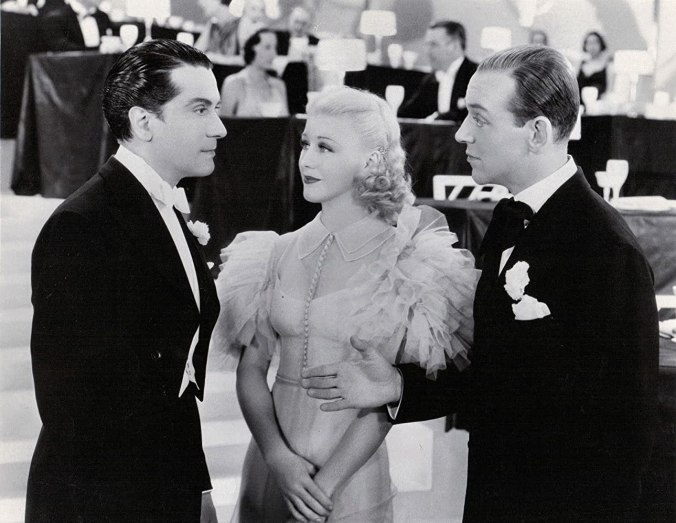
Jordan: But that was their job! Ricardo wanted Penny to marry him, she kept saying no, so he decided he wouldn’t play music so he could manipulate her into marrying him! He was a jerk! At the end when Lucky needed to delay the wedding so he could tell Penny he was no longer engaged and wanted to be with her, he used the same tactic his former cast mates used on him to stop Ricardo from marrying Penny. That’s when Ricardo realized Penny really wasn’t in love with him, didn’t want to marry him, and he couldn’t force her to marry him. That’s when he began laughing with everyone else. The way the film plays everything out, everyone is okay with everything and no one is upset.
Michael: It just seems very unrealistic that he would be like, “Ah, you just stole my pants and my wife! Ha ha ha! Let me play you a song!”
Jordan: Well, it’s not a realistic movie. It’s a lighthearted musical tale.
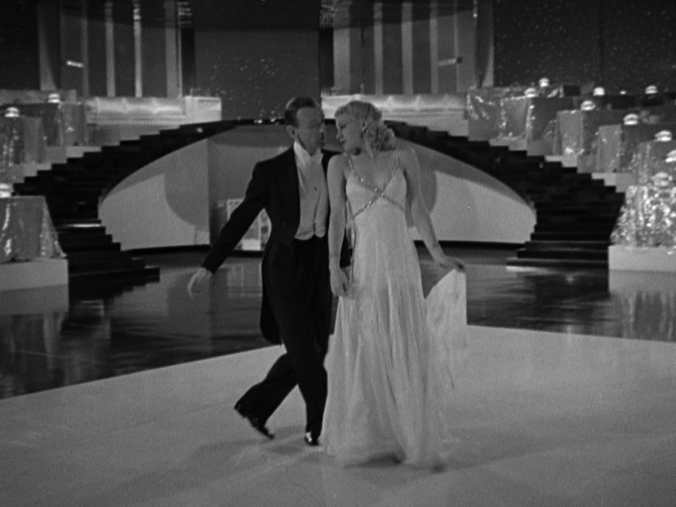
Jordan: I think this film is really great because not only is their dancing really good, but the music is all excellent. It’s all standards. Even today people will recognize almost everything they sing. I didn’t realize “The Way You Look Tonight” was from this movie and won the Academy Award for Best Song.
Michael: The dancing is very spin-y. And the costume designer knew exactly what they were doing.

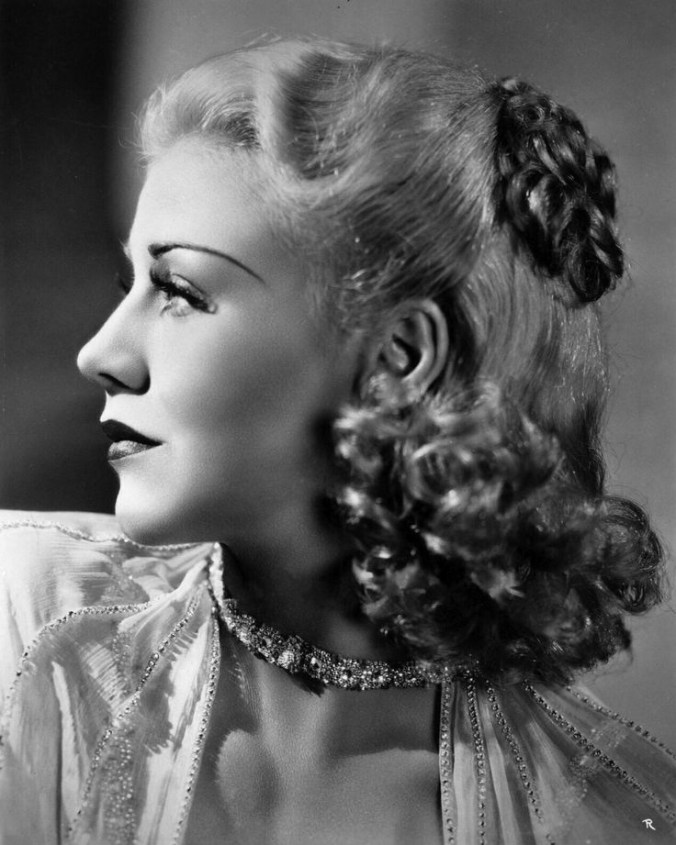
Jordan: Exactly! Ginger Rogers’ costumes were just beautiful. And it was choreographed so well, the timing of when she would pick up the dress, when she would let it just spin, I loved all that…what? What are you looking at me like that for?
Michael: No reason…
Jordan: You have a weird look on your face. What?
Michael: No reason. Nothing!
Jordan: What?
Michael: Nothing! Let’s keep talking! …I also thought Ginger Rogers was beautiful.
Jordan: O…kay…. What’s that face?
Michael: Nothing! We’re just discussing this movie with Fred Astaire and Ginger Rogers, and I knew who that was the whole time!
Jordan: You didn’t know that was Ginger Rogers? You didn’t know that was Ginger Rogers?!?!?!
Michael: Um, of course I did, I said I did! And if you write this conversation down in a blog, the record will show I said I knew who that was the whole time!
There were several moments I was watching this film and recalled what Gene Kelly said about dancing for film. He discovered when filming one of his famous stage moves, traveling from one side of the stage to the other, that it didn’t work. It was because the camera just stayed on him and tracked with his movements. The audience could not get a sense of the scope of the step as it just looked like he was doing it in place. However, if the shot was wide enough to see the immensity of the stage, then it’s too far away to see the intricacies and Kelly would be too small on screen. The camera sees the stage differently than someone in the audience who may be watching from the balcony because the audience can focus on the performer and narrow their scope of attention. In film, the camera is already the audience’s narrowed scope.
In this film, all of the dance numbers are in wider shots so the audience can see the full bodies of Astaire and Rogers the whole time. This was apparently a demand that Astaire made for all of his dance sequences. The camera sometimes pans along with them, but the choreography also looks as if they dance on diagonals to stay within the camera frame.
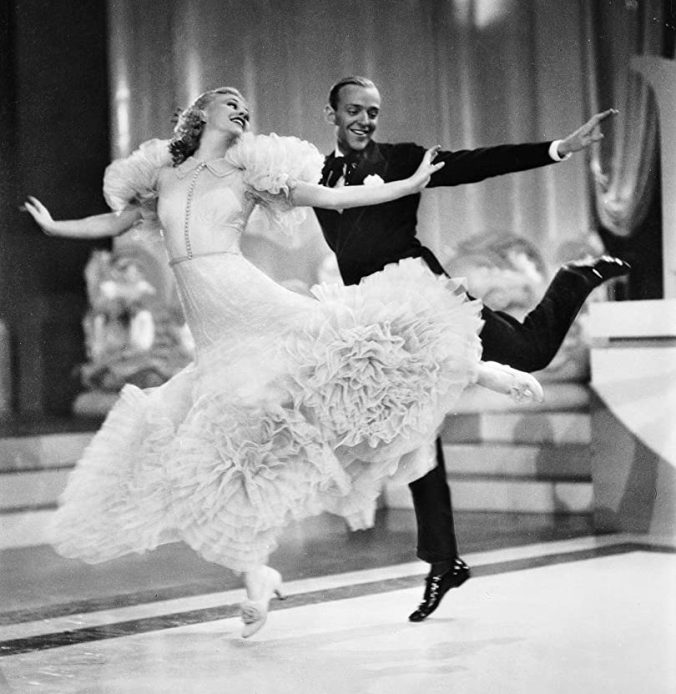
Michael: It looked like a lot of arcing.
Jordan: Yeah. It was very interesting to watch because the movements were all very beautiful, and it seemed like the goal was to keep the camera from moving as much as possible. They also did so many of these numbers in one take! (Another demand of Astaire.) That’s so much fun to watch! That first dance together in the dance studio from the moment they jump that barrier is all one take until they jump out again. It’s great! I wonder why when people make musicals today, and choreographers are directing these musicals, they cut so much and they have so many close ups on the performers’ faces. It’s their feet and bodies that are doing something interesting! We don’t make musicals like Swing Time anymore where the audience can actually see what the dancers are doing! I don’t know why!
Michael: Like the movie musical of Hairspray was a fucking mess. They have 80 dancers doing this choreography, but it’s a close-up of this kid doing a barrel turn and I’m like, “What the fuck am I looking at right now?”
Jordan: Right! Which makes no sense! Why did you choreograph this huge number, work so hard for everyone to get it right, and then you, the choreographer who is also the director, cuts out all the dancing? Who told you that was a good idea? Or did you decide it was a good idea? The camera isn’t focused on the dance or the bodies that are in motion, we’re just watching five faces smiling while bouncing around, then cutting to random reaction shots. It doesn’t look impressive!
Michael: And it happens a lot especially in music videos and modern musicals, where choreography doesn’t move anymore. It’s everyone dancing frantically in one spot. So they hit a formation and then just dance in the formation. It bothers the fuck out of me, which is why I love choreographers like Rob Ashford and Casey Nicholaw because their dancers move around the stage. There’s movement in place, and then the movement moves. For some reason people think they don’t want to see actual movement anymore.
Jordan: Because it doesn’t look frenetic. I think people assume if it looks frenetic they’ll catch the attention of the modern ADHD mentalities of today.
Michael: People assume it looks harder to people today if the dancers are standing in one spot and flailing around. People then say it’s intricate when really it’s “Wacky Waving Inflatable Arm-Flailing Tube Man”.
Jordan: That why it’s great to watch this movie. You see this wonderful, graceful dancing with choreography that moves. And they move so well together! Ginger Rogers just looks so beautiful. There’s this incredible line happening in her movements. And when there is camera movement, it’s emphasizing that beauty by mimicking the grace of Rogers and Astaire. That crane shot during their final number is just wonderful.
There is no way to talk about Swing Time without referencing the “Bojangles of Harlem” number. Though the dancing is technically proficient and very impressive, performed with the same lighthearted joy as the rest of the film’s numbers, there’s no way either Michael or I could feel comfortable with the fact that Fred Astaire was dancing in blackface. Criterion includes an excellent special feature on the disc of an interview with film scholar Mia Mask. She gives historical context for the number, summarizing the origins of minstrel shows and blackface performers. She then gives context for what was happening with African American performers in Hollywood at the time, focusing on Bill “Bojangles” Robinson, the artist referenced and supposedly paid tribute to in the number.
Many interviews I’ve seen with film scholars (mostly white men) claiming today’s audiences need to put these numbers into context at the time find a way to excuse the numbers by saying people didn’t know better back then. Mia Mask says the same thing about putting this number into context at the time, but details how even at the time the number was a purposeful erasure. She states that the studios knew what they were doing at the time because there were many rules in place regarding the appearance of black actors on screen and how they were supposed to be portrayed in relation to the white stars. At the time Swing Time premiered, Bill Robinson had done so much work breaking down those barriers for African American performers, going so far to not only touch white actors in films, but holding the hand of Shirley Temple as they danced a duet. This was forbidden under studio rules at the time. Mask asserts that Astaire performing in blackface as Robinson is a purposeful erasure the studio would have deliberately undertaken.
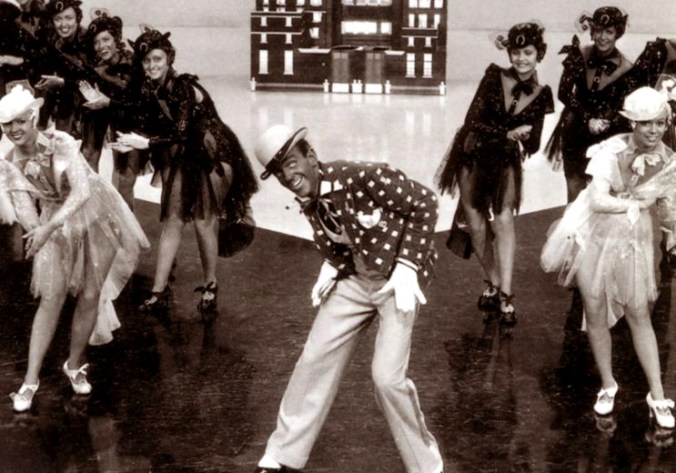
Michael: I can see how Fred Astaire might think he’s paying tribute to this dancer he respects by doing this number, not realizing he’s viewing it from a point of privilege and doesn’t know what that would be like for Robinson or a black audience member. And that reveal with the set piece of the shoes!
Jordan: Yes, that was horrifically offensive!
Michael: There is no way that is legit. You’d have to be a really sheltered person to think that was okay. Though, you know, no one does sheltered and privileged like white people. That is one thing we do better than anybody else. And you can imagine the sheltered white person seeing this movie in the theaters at the time and saying, “What a wonderful homage!” What a horrible time to be alive.
Jordan: Some things aren’t much better now.
Michael: Yeah, some places it’s still like that. But I can see how Astaire might not understand it fully.
Jordan: As opposed to the studio executives who knew what they were doing. Though, maybe Astaire also knew it, I don’t know for sure.
Michael: We want to give him the benefit of a doubt because we like him.
Jordan: Right. But maybe he was just as complicit and knew.
Michael: That’s the funny thing about racism. You can like people of other races and still be racist, mostly because you think because of your affinity you’re immune to racism. But you can still do some racist things or say racist shit.
Jordan: And we’re only going to progress if we recognize it, own it, and take purposeful steps to not repeat that behavior anymore.
Though “Bojangles of Harlem” may leave a bad taste in one’s mouth, the rest of Swing Time is rather delightful. The score is wonderful. Most of the songs would be recognized by audience members today, which makes watching even the non-dancing numbers enjoyable. Astaire and Rogers are at the top of their game here and are assisted by a wonderful supporting cast.
Michael: It was enjoyable. I don’t know if I need to watch it again.
I, for one, will watch Swing Time again any day I feel blue and want a lighthearted diversion. I may just decide to fast-forward the one number. Or, better yet, look up films starring Bill Robinson and make my own double feature.
Michael’s Rating: Three Reprises and a Medley
 Jordan & Michael Watch Movies!
Pingback: Bonus Tidbit! Super Gay Tangent from Swing Time | Jordan & Michael Watch Movies!