The Swimmer
Directed by Frank Perry
You see, if you make believe hard enough that something is true, then it is true for you.
Ned Merrill in The Swimmer
1968’s The Swimmer, adapted from a short story by John Cheever, is one of those films I’ve heard about periodically throughout my life but I hadn’t yet seen. Criterion Channel had a Burt Lancaster retrospective featured during the month of March (sadly, currently over), and I was delighted to see this was one of the films in the line up. Since the movie was a svelte 95 minutes, I figured it would be a good movie to watch with Michael.
Boy, was it a crazy ride! I looked up the director’s credits after watching the movie and saw he had also directed that wonderful camp classic Mommie Dearest.
The more we talked about it, the more we realized how good the movie really was.
Michael: What an interesting film. It would be an interesting movie to watch one more time at some point down the road knowing what we know at the end.
Jordan: It’s weird to me because I really liked parts of it a lot. I like the overall idea of it. I think there was a lot more well done in that film than initially met the eye.
Michael: Probably. That’s why I’m saying it deserves a second watch before judgement is passed.
Jordan: I still think the music is a little overblown, and the soft focus/lens flares/slow motions/pans and dissolves are overdone, but they do it on purpose to support the theme. So I understand the choices. And the movie is actually pretty great.
Michael: It was a very good film.
And the most important take away from the movie:
Michael: Who knew Burt Lancaster could get it?
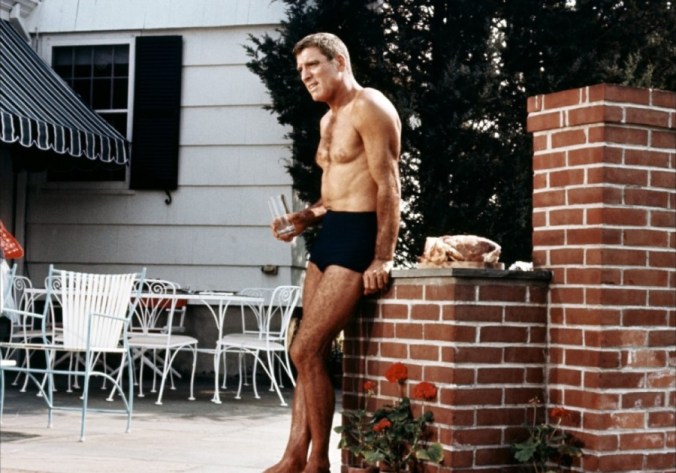
SPOILERS AHEAD! And I don’t mean that lightly! This movie is quite an experience if you don’t know know what to expect. We certainly don’t want to ruin that for you…
How to describe the events of The Swimmer in a way that makes sense?
It opens on Ned Merrill (Burt Lancaster) jumping into his friends’ pool and swimming a couple laps. He pops up and begins talking to his friends. Turns out they all live in a sprawling suburban neighborhood where everyone owns large pieces of land with woodland areas between houses. These particular friends live on the far side of the neighborhood from Ned’s house. As they (awkwardly) talk with each other, Ned finds out some other neighbors have recently put in a pool. Ned gazes off across the neighborhood, and we hear a voiceover.
Michael: You know right away something’s wrong because he stares off into the distance and begins thinking, “I can do it…”
Jordan: And things go all soft focus with overlays and stuff.
Michael: Yeah. And I’m thinking, “Is he having a whole musical number in his head that we’re not seeing because this isn’t a musical? What’s going on here?” So we know from the jump shit’s not right.
Ned turns to his friends and neighbors and tells them his idea. Now that everyone has a pool in their backyard, he can “swim” home. Sure, he doesn’t have a pool himself (they have the tennis courts his daughters are surely playing on right at this very moment), but every neighbor between here and his house has a pool. He’ll start with this pool, then go next door, swim another lap, and continue on all the way to his house. He’ll name this river of pools Lucinda after his wife. The neighbors are perplexed and halfway delighted by this idea.
Michael: It was like, “I’m going to swim all the way home.” Well, what a quirky little fuck you are!
Ned just can’t remember: Who’s owns that second to last pool, before the public pool near his house? The answer is Shirley Abbott (Janice Rule), which causes Ned to make a weird face.
Oh, well. What ho! Off Ned goes, jumping into the neighbor’s pool, swimming a lap, and hopping out to continue through the woods. At each backyard Ned encounters someone else he knows, someone else from his past, or someone new he is intrigued by. At every back yard the audience learns more and more about Ned, and Ned learns more and more about himself.
He walks through one back yard and the woman there is angry at him for what he did to her son (the details of which are never explained, but it is clear her son is now dead). His neighbors who have just put in their new pool are very proud to announce they have the latest in high tech cleaning systems, filtering out 99.99.99 percent of filth and contaminants.
Michael: That’s…not how percentages work….
He runs into Julie Hooper (Janet Landgard), the babysitter he used to hire to watch his girls. She’s now in her 20s and very beautiful. He invites her to join him on his journey, and she accepts! How fun! They wander through the woods between pools. Julie admits to having a schoolgirl crush on Ned when she was younger. How droll! They crash a pool party and are welcomed with open arms and delighted guests, until one of the interactions turn sour. They leave and decide to play in an obstacle course set up for horses. Ned hurts his ankle, so they rest in the woods. After some rather intense conversation where Ned gets a bit creepy, Julie runs away.
Jordan: Atta girl!
Ned continues on alone. He meets his friend’s chauffeur as he’s coming up the drive, but this isn’t the chauffeur he remembers! How could he confuse this man with that man? (My guess was racism.) He says hello to his nudist neighbors, kindly taking off his bathing suit before approaching them so as to fit in. He meets a young boy, Kevin Gilmartin (Michael Kearney), left all on his own while his mother is away. The kid needs some adult guidance, and Ned’s the one to give it! “I have some daughters around your age,” he tells Kevin. Wait. What? No…. Hmmm…. Ned then crashes another pool party, which offers him a chillier reception.
Michael: I loved our little meerkat moment when we both sat up like, “Mehr? Is that Joan Rivers?”
Jordan: She was really good! I’m not used to seeing her in dramatic roles!
Michael: Oh, yeah! I mean, it was a little bit part, but it was nice.
Jordan: She filled it out really well!
As he goes along, Ned gets more and more tired, more injured from walking between the different yards, more beaten down. By the time he gets to Shirley Abbott’s house, he’s a bit desperate and damaged. She offers no solace, and we find out Ned had an affair with her and treated her horrifically.
Michael: I thought the scene with the ex-lover was horribly staged. I get it, this is probably very jarring for her and she’s flustered and wants to get away from him, but there was a lot of movement for movement’s sake.
Jordan: A lot of her movement read as her feeling very uncomfortable and not knowing what to do, but she still didn’t want to yield her ground. It’s her house, it’s her pool, he intruded on her. But I think you’re right, a lot of the actual staging in the scene was not really masterful.
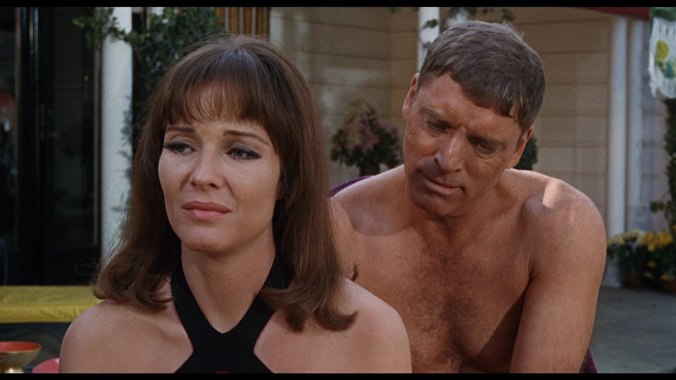
Shirley eventually kicks Ned out of her backyard, saying she does not love him and he was terrible in bed.
Jordan: Atta girl!
From there it’s on to the public pool where Ned is humiliated. He has no money on him to pay the entry fee. He has to beg the money from the owner of a bar he once frequented. The bar owner’s wife is enraged at this, but the bar owner eventually lends Ned the money. He is made to wash not once but twice in the showers before entering the pool.
Michael: I had that nice moment of vindication where I had been thinking, “His feet must be filthy from jumping in and out of all these pools!” Then he gets to the public pool and the guy is like, “Go take a shower. No, go wash your feet. Show me between your toes.” That guy was like, “Not on today, sir. Not in my pool you’re not.”
Jordan: It felt a lot like those scenes where people are being admitted into prison and being strip searched and hosed down. Ned was feeling that kind of humiliation, and I was thinking, “Dude, you’re at a public pool. If you’re feeling this level of humiliation, then you’ve been really sheltered your whole life.”
Ned tries to swim the pool, but it is so crowded, so loud, so many people jostling and splashing. He can barely make it through. He’s met on the other side of the pool by the bar owner, his wife, and another couple who all really, really hate him. Turns out they have good reasons. Ned suffers the verbal assault until he can’t take it anymore, then pushes them aside and runs away.
Michael: In that scene I was thinking how the bar owner’s wife was a case of someone who had been told her whole life that people wouldn’t punch her in the face because societal rules say they shouldn’t. Because she was being so nasty to him. Not that she was unjustified for her feelings about him, but she was being unnecessarily nasty to him.
Jordan: I don’t think she was. Ned’s been a rich asshole who never paid his bill and his daughters have terrorized their town with their drunk driving. Now, Ned has shown up at her public pool (she can’t afford anything else) and asked her husband, who he still owes a lot of money to, for fifty cents so he can swim in their public pool. No, I can see why she’s completely pissed the fuck off. And Ned has ruined his own career, so she knows he’s a fuck up who is now at their pool asking for their charity and has done nothing to try to repay them the debts he owes them.
Michael: And done nothing to deserve their charity, either.
Jordan: It’s not her who thinks she can do or say whatever she wants and society dictates someone won’t punch her in the face, it’s Ned who society has told he won’t be punched in the face. Which is why she’s so nasty to him. And her husband’s trying to keep the peace until Ned just won’t get it. That’s when the husband decides no, Ned has to face some reality here.
By the time Ned gets to his house he’s a defeated shell of a man, no longer the playful boy-like swimming enthusiast we started out following. He’s desperate to get inside his house. But he won’t be getting into this house now or ever. His wife and daughters are gone. This is no longer Ned’s house. He is alone and delusional, trying to get back to a life he no longer lives.
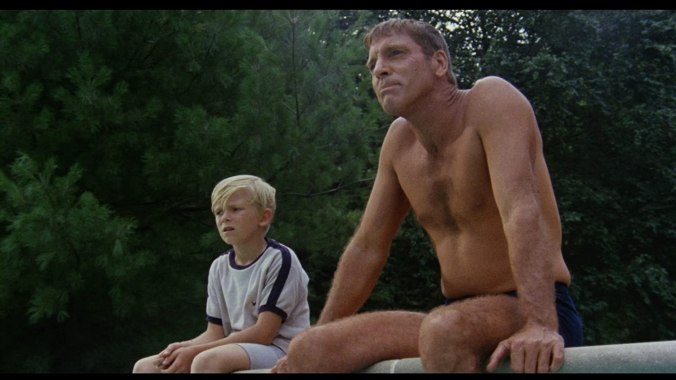
Michael: At first I thought it was all poorly directed and badly acted, but it wasn’t. For me, we get to that scene with him and the little boy and that’s when I realized, “Oh, no, shit’s really wrong with this guy. This isn’t just ‘he’s some quirky guy’, this is something is legit wrong with him.”
Jordan: The other moment in that scene that gave me a huge clue something was completely off was when he told the kid, “If you think it in your mind, it becomes real for you. So it is real.” That’s when I was like, “Oh, sir. This is what you’ve been doing this entire time.” When the movie started I thought this was one of those 60s movies about how crushing and boring suburban life was, and if people just had some imagination and whimsey and dared to be different they could be free! And it wasn’t that at all.
Michael: It wasn’t.
Jordan: It did show another perspective on how suburban life can be false and a place to play pretend while there’s something rotten under the surface. But it wasn’t one of those, “If everyone’s like the hippies then we’d be fine!” It was more like you’re not going to escape reality by going somewhere fun and fancy free in your head. There’s no escape into imagination. That’s just as bad as the suburban life.
Jordan: I have never seen so much soft focus, lens flaring, zooming, panning, soft shot, slo-mo, and insanely melodramatic music before in my entire life. It’s trying to show that he’s in this dream world in his head, which is slowly crumbling. I get it. But it took me really off guard at first. The techniques themselves you could still use today, but the way they were used in this film was so 60s! They just seemed so over the top and exaggerated, but the themes were so grounded. The different touchstones along the way had a center to them, even though all the actors kept playing every scene like they were on a stage in a black box community theater. There’s this big push/pull of elements I liked a lot versus elements that made me think, “What the hell was that?!”
Michael: When it started, I thought, “Why is everyone the most awkward person that has ever existed?” They were obviously good friends, they haven’t seen each other in a while, so we’re playing catch up as audience members. I appreciate films that don’t have oddly expositional phrases.
Jordan: All their lines in those opening scenes were very surface level small talk. No one was having a natural conversation with each other.
Michael: Yeah, I appreciate that. But everyone was just awkward as fuuuuuuuuuuuuck. It was so off-putting to me. I wanted to take my phone out and start looking at it, not because I wasn’t interested in the movie, but because I felt so uncomfortable I needed to disengage from it. Which in hindsight I’m sure is what they were going for.
Jordan: And it’s what I liked about it in the end.
Jordan: I can’t get over the fact that every single time he dove in a pool, he belly flopped. It wasn’t even a shallow dive, just flopping into the pool in a diver’s pose.
Michael: It’s The Swimmer. Except he can’t dive in the pool. Bless him. But how did that not hurt, though? Some of them looked really painful!
Jordan: They really did! And it was consistent! Every time!
Michael: Do you understand that your hands are supposed to break the tension? You’re trying to go in the water, not skid across it.
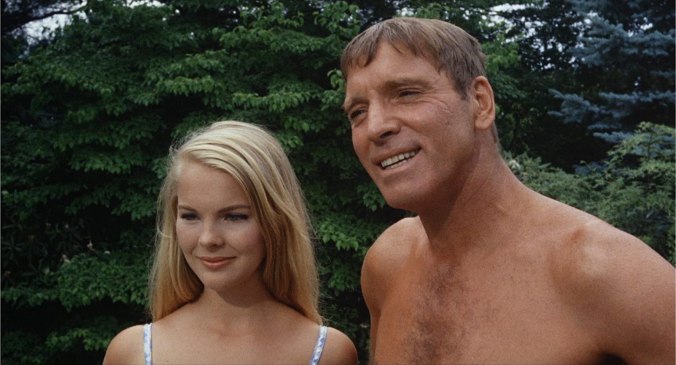
Michael: I was surprised Janet Langard didn’t do much after this.
Jordan: She was really good!
Michael: IMDb says her last credit was 1972, so obviously, she left acting to do something else. She was a good actress, a beautiful girl. She was the first person in the movie where I was like, “Oh! Someone who’s not awkward as shit! Thank you!”
Jordan: But that’s down to the character that she was playing. All the other people up to that point had had adult relationships with Ned and knew more about his life and what was happening to him. She didn’t know any of that.
Michael: Though it was super awkward when she was revealing, “When I was little I was in love with you and thought you were a god and stole your shirt.” I was like, “This is real extra right now.” And then it gets to the point where he wants to kiss her and she’s like, “No, stop touching me.” I wasn’t sure how much I bought that she was in love with him as a kid and now he wants to kiss her, and she tells him to get away.
Jordan: I buy it because she’s now grown up. When she tells him about when she was younger, it’s in the tone of, “Oh, when I was little I had this crazy, creepy crush on you. Isn’t that funny?” I can completely understand that now she’s an adult, she’s looking back on her younger self and thinking about how silly she was. Those feelings aren’t the same now that she’s more grown up.
Michael: I don’t know. I don’t think there would have been someone who I would have been totally in love with when I was 12 who I’d be creeped out by in my 20s, but maybe I’m just not that kind of person.
Jordan: I would have been. If I had that kind of crush on an older man while I was babysitting his kids and then ran into him when I was in my early 20s, I don’t think I would’ve had those same feelings or wanted him to pursue me sexually at that point. Especially if I thought he was still married like Julie thinks he is. It also shows the difference between the two of them. He’s in his 50s and trying to be in his 20s, but he was childish in his 20s. She’s in her 20s and becoming an adult making adult decisions. She is gradually revealed to be the more emotionally mature one in these scenes.
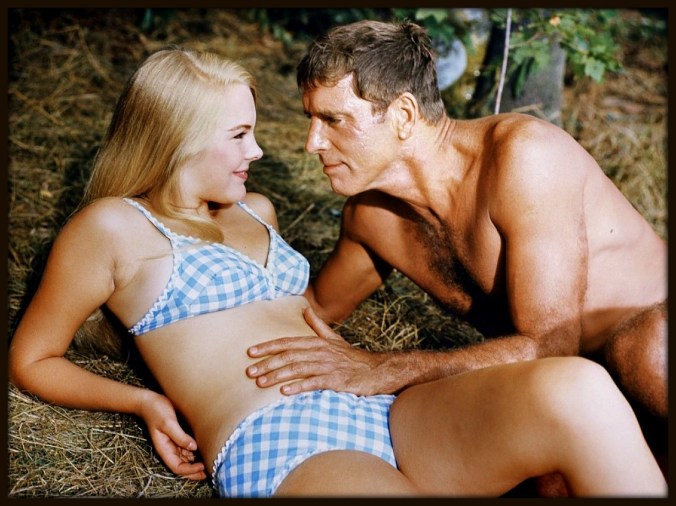
Michael: I love how the movie started with everybody loving him and all the women want to fuck him. Until they did fuck him, and then they were like, “No, we’re done with you. We’re sooooooo done with you.”
Jordan: I had so many “Atta girl” moments during this movie. (For those who don’t know, when I say “‘Atta girl’ moments” I’m referring to the drunk office worker from 9 to 5 who slurs, “Atta girl” every time one of the main female characters stand up to their chauvinistic boss.)
Michael: He meets Julie who’s 20 now, and he immediately becomes Creeper McGoo. I wonder what it would be like watching this movie 50 years ago when it came out. Was it Creeper McGoo then? Or have we just shifted now to, “No, 50 year old man, you shouldn’t be holding on to this 20 year old girl’s arm like that”?
Jordan: This is what I really, really liked about this movie. The movie was about a middle aged rich white man who has lost everything, and he’s now coming face to face with what the world actually is. The girl tells him about these men who sexually harass her, and his response is to say, “Oh, I’ll take you to work every day, and we can have lunch together, and I’ll take you home” and he puts his hand on her stomach. Which is a similar thing these men do to her. She gets up and runs away, and he’s just perplexed, realizing that he’s just done the same thing to her that these other men do.
Michael: I don’t think this moment is him realizing he’s been sexually harassing women this whole time, I think this moment was him being like, “What? But you said you were in love with me?” It seemed more general confusion brought on by his mental state. These moments of complete disconnect were jarring for him because it was separate from this privileged existence that he lost.
Jordan: I don’t think we’re talking in opposition to each other. The whole movie he has these moments of coming up against the truth of the world and how he can’t handle it. He thinks they can’t be right. We see how when he was younger it seemed like everyone wanted to be his friend or was attracted to him, but that was all surface level. He didn’t change his behavior as he aged, and now he’s perplexed when people are mad at him for not learning how to grow up. He starts getting cold, and people begin rejecting him more and more. He can’t cope with it. It’s a whole movie of someone who is trying so hard to not recognize reality he’s having a mental breakdown over it. Reality is just going to keep coming back harsher and harsher and harsher the more he resists it.
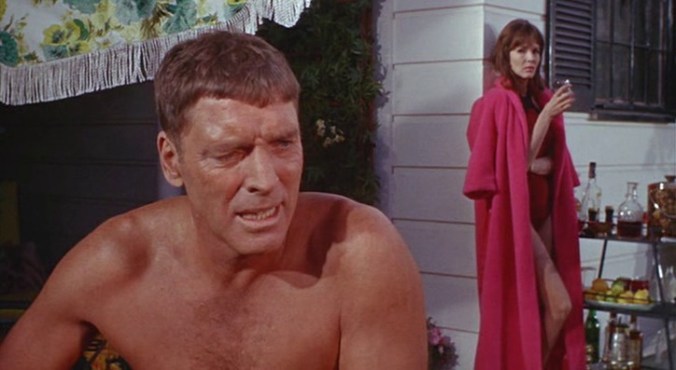
Michael: I’m going to be a bad musical theater gay right now and say I’ve never been a fan of Marvin Hamlisch. I mean, he’s fine, but I’ve never thought he was amazing and brilliant.
Jordan: Marvin Hamlisch was very current in his time. His music was very popularly current.
Michael: There was that whole moment in the horse pen where the music became a Final Fantasy battle sequence, and then it just stopped abruptly. Then there was that moment at the end, where I felt like Marvin Hamlisch was only told, “And then he gets to his house,” because the music sounded so happy and “*singing dramatically* I’m finally HOOOOOOOME!” I was like, “Marvin, did you know what movie you were scoring, boo boo?”
Jordan: But at that point the music was highlighting the expectation of his mental breakdown versus the reality of what was going on. The music isn’t doing the melodrama of “this is what the audience should be feeling”, it’s doing the melodrama of “this is what Ned is feeling” which is what it’s been doing the whole film. That’s why it’s so overblown and crazy and big. Again, my personal taste would’ve been to have that done differently, but Hamlisch was scoring this for the film in 1968, so it makes perfect sense for the time period in which it’s set.
Michael: And then there was that chicken crosses the road moment.
Jordan: That whole scene was very 60s.
Michael: I thought that scene was shot and edited incredibly well. All the shots were just cars driving by and him looking around, but the way it was edited made you feel like he was just spinning and about to fall into traffic. That was an incredibly well done sequence even though the music was maybe more intense than it needed.
Jordan: I hated that scene. It was just that usual 60s montage of quick cuts indicating panic and “Oh, the world!” I hate it so much and am so sick of it. But that’s because I’ve seen it so much from films in the era and beyond. It was a widely used convention, and it served the story well in this film. I felt like so much of the film was that. It was a lot of 1960s film techniques being used to tell this story about this man’s mental breakdown, and the reason it might date poorly for audiences today is because the conventions are dated. Overall, the film is told so well that if you’re able to push past those conventions, you’re going to be able to see a movie that’s worth watching.
Michael: Yes. It’s definitely worth watching. It’s a good movie. Now, it’s the same kind of good movie that Precious was a good movie, and I haven’t seen that since it was in theaters because I just can’t. This is a movie I could watch one more time because I’d want to see the things I might have missed, but then I wouldn’t ever want to watch it again. Not because I didn’t like it, but because it’s a lot.
Jordan: Yes, it is a lot. I’m glad it ended up being a lot. That first half hour felt like it might be the pretense of a lot, and I got really nervous. But then it gets to the end, and it makes perfect sense.
Michael: If there’s a movie you want to watch just for daddy dick, it’s this one.
Jordan: It really was! There were a couple moments where I was like, “Oh, sir! Oh my!”
Michael: Cause they did not shy away from it.
Jordan: They did not.
Michael: It wasn’t like “Let’s bring the camera up just a little bit so you can’t see the whole thing.” They said, “Nope. Let’s put that on display a little bit.”
Jordan: That scene where he was talking to the little boy and they get in the pool without water, I was like, “Oh, my God!!!” His penis was a third person in that scene.
Michael: And there was another scene where I was like, “His dick is doing a monologue right now. This bathing suit does not have much support! He’s loosey goosey!” This was Labyrinth level bulge happening. More so, because he’s on screen the entire film, and Jareth isn’t onscreen for over half of Labyrinth. This is an hour and thirty five minute of daddy bulge. And I’m not mad about it.
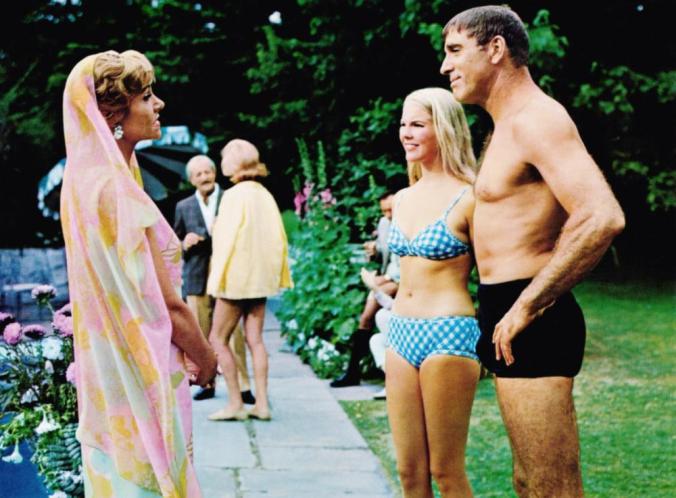
Michael: I was initially checked out because I thought it was bad acting and awkward moments. Then it was forcibly awkward, and I felt like I needed to disengage because I was so uncomfortable. Then it hit that turning point where it became engrossing. If this was a movie that was on TV and I was home by myself, I would have shut it off. Twice. Had I not shut it off in those first two scenes, I would’ve shut it off after the scene with Julie.
Jordan: Yeah, I would’ve written it off in the first half just due to the supposed bad acting and the cinematographic choices and the overly dramatic music. I was watching it thinking, “Why did the critics like this movie so much at the time?”
Michael: It was obviously designed as a movie where you take the whole thing in. Because you need to stick with the movie for the whole hour and thirty five minutes.
Jordan: Since it’s just over an hour and a half, it doesn’t overstay its welcome.
The Swimmer is well worth the price of admission. It’s a crazy and intense little allegory that can be applied to several different real life situations: Is it the full life of a man where every pool represents a turning point in his life? Is it the personification of a mid-life crisis? Is it what happens to affluent middle aged white men who are shocked when their ignorance is finally pierced by the sharp sting of reality? It’s all this and more! It makes the film worth viewing multiple times. I’ll be excited to see it again the next time Criterion Channel is able to stream it (or possibly when they get the rights to release it on disc with special features! One can only hope…)
Michael’s rating: 99.99.99 Percent Bulges
 Jordan & Michael Watch Movies!